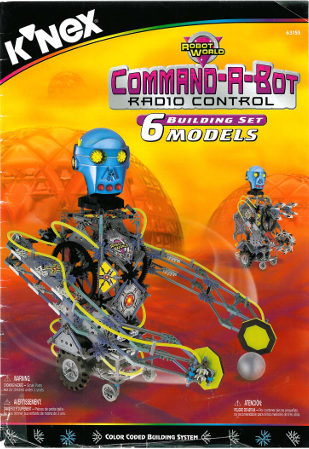
In 1999, K’NEX offered a remarkable construction set that combined traditional building techniques with radio control, independently controlled motors, light effects, and voice transmission.
Part of the Robot World series, Command-A-Bot offered builders the opportunity not only to construct their own robots but also to bring them to life.
Unlike conventional motorized K’NEX models, these robots could be controlled remotely, perform different mechanical actions, and even speak using the builder’s own voice.
Welcome to Robot World

“Where Robots rule and you rule the Robots!”
With this slogan, K’NEX introduced builders to a world in which they could create and control their own robotic machines.
The original packaging presented Command-A-Bot as the “King of the Robots,” emphasizing the combination of construction, movement, sound, and direct control.
The concept was simple: build your robot, activate the Remote Control Command Center, and take control.
The Command-A-Bot Building Set
The original Command-A-Bot building instructions identify the set as number 63155 and provide the following information:
- Series: Robot World
- Set number: 63155
- Year: 1999
- Number of pieces: 644
- Number of building models: 6
- Control system: Radio Control
- Instruction booklet reference: 95265-V1-5/99
The set combined familiar Classic K’NEX components with specialized mechanical and electronic parts.
The Remote Control Command Center
One of the most distinctive features of Command-A-Bot was its electronic control system.
According to the original packaging, the system featured:
- Four independently controlled motors
- Eight separate control actions
- Voice transmission
- A flexible antenna
- Dynamic arm action
- Forward, backward, and spinning movements
- Illuminated eyes and mouth
The main electronic components were the Power Unit, the Head, the Hand Controller, and the external red and blue motors.
The original instruction booklet included separate operating instructions, battery installation information, and a troubleshooting guide in English, French, and Spanish.
Giving the Robot a Voice
Command-A-Bot offered more than mechanical movement.
A microphone incorporated into the Hand Controller allowed the builder to transmit their voice to the robot. The robot’s head featured illuminated eyes and mouth elements, adding to the impression of a living robotic character.
The Power Unit also incorporated a control identified in the instructions as the Robot’s Voice Enhancement Dial.
Rather than relying on prerecorded speech, Command-A-Bot allowed the builder to become the voice of the robot. This was a voice transmission feature, not a voice recognition system.
Six Models, One Building Set

The original instruction booklet provided building instructions for six different robots:
- Command-A-Bot – the principal robot model, featuring a large articulated mechanism at the front.
- ButlerBot – a robot designed around a carrying and serving concept.
- Tall Grab-A-Bot – a tall robot featuring grabbing mechanisms.
- CraneBot – a mobile crane with an extended lifting arm and grabber.
- Toss-A-Bot – a robot featuring a throwing mechanism.
- SpinnerBot – a robot incorporating a spinning mechanism.
Each model demonstrated a different way of combining the electronic control system with K’NEX mechanical constructions.
The same components could be rearranged to produce different movements and functions, illustrating the versatility of the K’NEX building system.
Special Mechanical Components

Command-A-Bot contained several distinctive components in addition to standard K’NEX rods and connectors.
These included:
- Large black five-spoke gears
- Gray perforated construction panels
- Wheels and tires
- Yellow flexible rods
- Yellow octagonal panels
- Yellow flexible tubing
The flexible yellow tubing was used to create curved outlines around the robot’s structure, contributing to its futuristic appearance. Its official K’NEX part name and part number have not yet been established.
The large gears, articulated arms, and structural panels helped create mechanical assemblies capable of performing a variety of movements.
Together, these components gave the Robot World models a distinctive appearance compared with many conventional K’NEX constructions.
One Robot, Two Names
An interesting historical detail is that original K’NEX packaging can be found under two different names: Command-A-Bot and Control-A-Bot.
Both versions belong to the Robot World series and show the same six robot designs, with the principal model named according to the product version.
The packaging also shows apparently identical electronic components, including the blue robot head, the Hand Controller, and the Power Unit.
Interestingly, the promotional text on the back of a Control-A-Bot package still refers to Command-A-Bot as the King of the Robots.
Whether the different names were associated with particular markets, distribution arrangements, or a change in product naming remains unconfirmed.
Command-A-Bot in 1999
Command-A-Bot also received attention in contemporary newspaper coverage.
On December 3, 1999, The Royal Gazette featured the set in an article titled Today’s toys are different, under the heading Build It.
The article listed a US retail price of $109.99 and highlighted the six robot models, remote-controlled movement, and the various spinning, turning, and grasping actions.
This contemporary reference provides an interesting glimpse into how the set was presented to consumers in 1999.
Building, Engineering, and Control

Command-A-Bot brought together several technical disciplines within a single construction set:
- Structural engineering
- Mechanical power transmission
- Gears and articulated mechanisms
- Electrical power
- Radio control
- Sound and light effects
Builders could explore how different mechanical arrangements produced different movements while retaining the same electronic control system.
Command-A-Bot was therefore more than a collection of robot models. It demonstrated how a modular construction system could be combined with electronics to create interactive machines.
Looking back, Command-A-Bot and Control-A-Bot represent a distinctive chapter in the history of K’NEX, when the familiar rod-and-connector building system was combined with radio-controlled robotics, sound, and light.
Building Instructions
The original Command-A-Bot building instructions remain available online.
View the original K’NEX Command-A-Bot 63155 building instructions (PDF)
Sources
- K’NEX Industries, Inc. (1999). Command-A-Bot 63155 building instructions, reference 95265-V1-5/99.
- Original K’NEX Robot World Command-A-Bot packaging.
- Original K’NEX Robot World Control-A-Bot packaging.
- The Royal Gazette (December 3, 1999). Today’s toys are different, section Build It.
Leave a Reply