Looking for a specific part or topic? Use your browser’s Find function to search this page for a term or part number: Ctrl+F on Windows or Command+F on Mac.
K’NEX models are built from families of components with different roles. Rods and connectors create the basic framework, while clips, wheels, gears, pulleys, panels, motors, chains, track and specialised parts add connections, movement, surfaces and other functions.
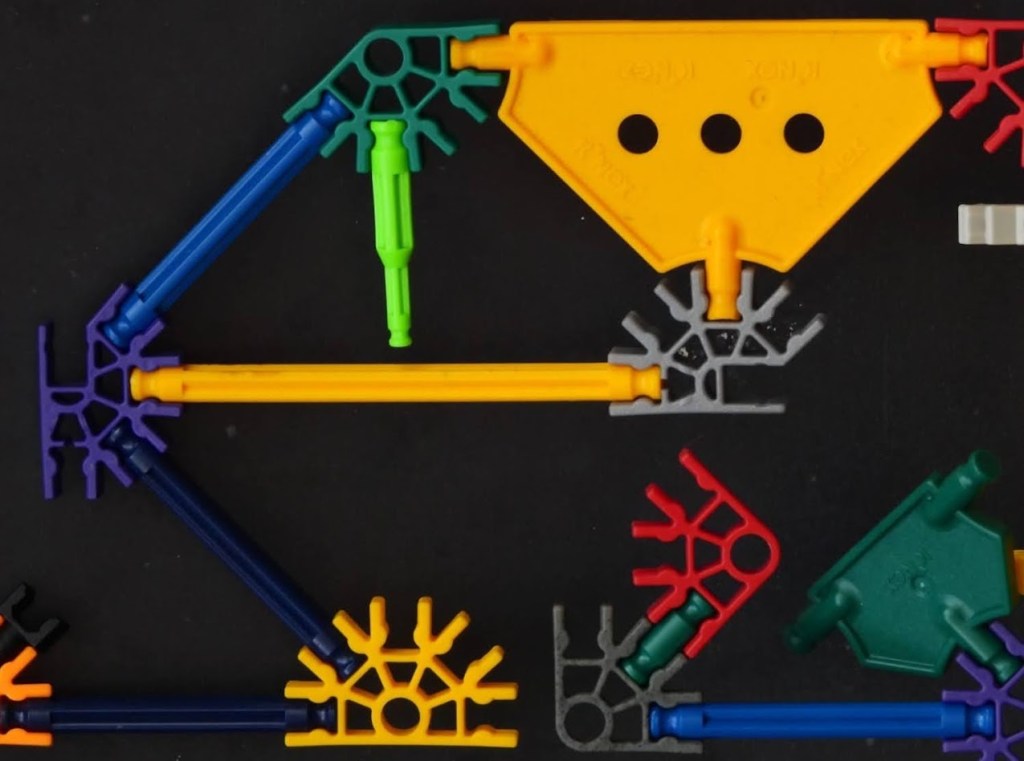
You do not need to know a part number to begin identifying a K’NEX component. Start with the building system and general type of part, then use its function, shape, dimensions, variant, colour and part number to narrow the identification.
K’NEXCHANGE uses practical Families to organise the catalogue. These are a way of grouping related components, not a single universal K’NEX classification. The same part can also be described by its system, function, shape, size, colour, application or Theme/Series.
A useful identification route is:
system → family → function and shape → size → variant → colour → part number
Looking for a specific part or topic? Use your browser’s Find function to search this page for a term or part number: Ctrl+F on Windows or Command+F on Mac.
Three main K’NEX systems
K’NEX components are commonly divided into three main building systems:
- Classic K’NEX — the original standard-size system;
- Micro K’NEX — a smaller-scale system;
- Kid K’NEX — a much larger system developed especially for younger builders.
Each system has its own rods, connectors and specialised components. Parts from different systems should not be assumed to fit together directly.
Classic and Micro K’NEX can, however, be combined in selected ways using transition rods, adapters and related components. Some sets deliberately contain parts from both systems.
The system is therefore usually the first useful characteristic to establish when identifying an unknown part.
How do K’NEX parts work together?
Rods provide distance and connectors provide direction. Their dimensions and connection points allow simple components to form much larger geometric structures. For a closer look at snap-fit connections, connector angles, rod-length geometry and three-dimensional construction, see How K’NEX Works.
Classic K’NEX
Classic K’NEX is the standard-size system and contains a wide range of general-purpose construction components.
Rods and connectors form its structural basis. Clips, spacers, caps, wheels, gears, pulleys, chains, panels, motors and many specialised parts extend this framework with additional connections, movement, surfaces and other functions.
Rods
Rods form the lines and edges of a K’NEX structure. Classic K’NEX uses six familiar standard rod lengths:
- approximately 16 mm / 0.63 in;
- approximately 32 mm / 1.26 in;
- approximately 54 mm / 2.13 in;
- approximately 86 mm / 3.39 in;
- approximately 128 mm / 5.04 in;
- approximately 190 mm / 7.48 in.
Colour was traditionally useful for recognising different rod lengths, but K’NEX rods have been produced in many alternative colours and finishes. Colour alone is therefore not a reliable identifier.
Not all rods are standard rigid rods. K’NEX has also produced Flexi rods, reinforced or extra-strong rods, rods with stops and other specialised forms.
When identifying a rod, its system, length, profile, flexibility and special features are generally more useful than colour alone.
Connectors
Connectors join rods and determine the directions in which a structure can continue.
Familiar Classic connectors include 2-way, 3-way, 4-way, 5-way, 7-way and 8-way forms, together with straight, angled, hinged and three-dimensional connector arrangements.
The term way refers to the available rod-connection positions. The number alone does not completely identify a connector: the orientation and angles of those positions are equally important.
A useful basic principle is:
rods provide distance; connectors provide direction
Clips and joints
Clips are generally smaller than the main connectors and perform more specialised connecting tasks.
Different forms include:
- hole-end and rod-end clips;
- rod-to-rod clips;
- angled clips;
- splice-end clips;
- interlocking clips;
- hinge components;
- ball-end components;
- socket-end components.
Some connections are designed to remain rigid; others deliberately permit rotation, pivoting or movement.
Small differences in an end, opening or connection angle can completely change the function of an otherwise similar-looking clip.
Spacers, caps and locking parts
Spacers position wheels, gears, pulleys and other components on rods and axles. Caps and locking components can retain parts, secure a position or finish a connection.
Correct spacing can be important in mechanisms: components fitted too tightly may create friction, while excessive space can allow an axle or gear assembly to move out of alignment.
Classic and Micro versions may look similar but belong to different scales.
Wheels, tyres, hubs and pulleys
K’NEX has produced many wheels for vehicles, machines and specialised models. Some are single components; others combine a separate hub or rim with a tyre.
Useful identifying characteristics include overall diameter, hub or rim diameter, tyre width, axle connection, tread and spoke pattern.
Pulleys provide another form of rotary component. Rather than meshing directly like gears, they can transfer movement using a belt, cord, rubber band or similar flexible element.
Gears
Gears transfer rotational movement. Gear size and tooth arrangement determine how gears interact and can alter rotational speed, direction and turning force.
K’NEX gear forms include:
- spur gears;
- crown gears;
- push-on and snap-on gears;
- partial gears;
- large gears;
- specialised multi-track or multi-level gears.
A spur gear can transfer movement between parallel shafts, while a crown gear can help transfer rotation between shafts in different directions.
When identifying a gear, examine its diameter, teeth, axle connection and the direction in which it is designed to mesh.
Chains and track
Individual chain links can be joined to create a chain of the required length. Together with a suitable gear or sprocket, chains can transfer movement over a greater distance than directly meshing gears.
K’NEX has produced chain components in different sizes and forms.
Track is more varied. Depending on the system, model and period, K’NEX has used flexible track, rigid sections, tubes and specialised coaster track. The correct track must match the relevant system and vehicle or coaster car.
Panels
Panels add surfaces and shapes to the open frameworks created by rods and connectors.
K’NEX has produced rigid, curved, flexible, latticed, decorative and specialised panels. Depending on their design and use, panels can be structural, functional or decorative.
Printed graphic panels intended to form part of a model should not be confused with packaging or printed inserts.
Bricks and adapters
Although K’NEX is best known for rods and connectors, brick-shaped components have also been produced.
These include bricks, plates, wedges, axle bricks, shelves and adapters. Adapters are particularly useful because they allow different construction principles or systems to meet.
Brick-compatible parts represent an extension of K’NEX rather than the central construction principle of the original Classic system.
Motors, electrical, light and powered parts
K’NEX has used a variety of powered and electrical components, including battery-powered motors, faster motor variants, mains-powered systems, spring and flywheel units, pull-back mechanisms, solar-powered components and specialised motors.
A motor provides movement, but gears, axles, pulleys, belts and chains may be needed to transfer that movement through a model.
Not every electrical component is a motor. Light & Sound components, control units, battery holders, switches, cables and mains adapters can have their own functions and catalogue classifications.
Different generations of powered components should not automatically be assumed to be electrically or mechanically interchangeable.
Flexible mechanical materials
Rubber bands, belts, cord and string can also be functional parts of K’NEX mechanisms.
They may store energy, return a mechanism to its starting position, transfer movement between pulleys or operate lifts and other moving structures.
When documenting an original set, an officially supplied flexible component should be distinguished from a later replacement.
Figures, animals and character parts
Figures and character components can include complete figures as well as separate heads, bodies, arms, hands, legs, eyes, jaws, claws, wings, tails, seats and accessories.
Some connect directly to rods or connectors; others belong to a particular figure system, set or Theme/Series.
Distinctive character components can be especially useful for identifying an unknown set because they may have appeared in far fewer products than common structural parts.
Specialised parts
Not every K’NEX component fits neatly into one traditional component family.
Specialised parts have been developed for roller coasters and amusement rides, vehicles, aircraft, figures and creatures, electronic models, blaster-style constructions, licensed themes, architectural models and many other applications.
An unfamiliar component should therefore not be assumed to be incomplete, unofficial or unrelated to K’NEX simply because it does not resemble a standard rod, connector or gear.
Micro K’NEX
Micro K’NEX applies the broad rod-and-connector construction principle at a smaller scale and has its own rods, connectors, clips, spacers, gears, chains, track and specialised parts.
Its components should not be confused with short Classic components simply because they perform similar functions.
Micro also includes flexible and specialised rods. Dimensions, profile and function are generally more reliable identifiers than colour.
Micro coaster parts
Roller coasters are particularly associated with Micro K’NEX.
Different track systems and coaster cars have existed. When identifying them, examine track profile, length and curvature, connection method and the car or set with which the components were used.
Some coaster cars have pins or other features associated with chain-driven lifts or particular launching systems. Similar-looking cars are therefore not necessarily interchangeable.
Original instructions and inventories can be especially useful when reconstructing a particular coaster.
Kid K’NEX
Kid K’NEX uses substantially larger components and has its own rods, connectors, wheels, figures, flexible parts and other specialised components.
Common documented rod sizes are approximately:
- 29 mm / 1.14 in;
- 55 mm / 2.17 in;
- 92 mm / 3.62 in;
- 145 mm / 5.71 in;
- 219 mm / 8.62 in.
Documented connector forms include 3-way, 4-way, 5-way and 8-way connectors as well as specialised forms.
Kid K’NEX also includes character, animal, eye, wheel and vehicle components, including parts with no direct Classic or Micro equivalent.
The larger components can be easier to see, hold and position and may therefore also be useful in some educational and supported-learning activities. Suitability depends on the individual learner, activity and required level of assistance.
Connecting different K’NEX systems
Classic, Micro and Kid K’NEX use different dimensions and should not be treated as freely interchangeable systems.
Classic and Micro can meet through purpose-designed transition rods, adapters, reducers and related components. Some sets deliberately combine both scales.
A transition component is therefore best identified by both systems it connects rather than only by the connection visible at one end.
Identifying and documenting parts
Once the general system and component type are known, measurements, colour, part numbers and small structural differences can help determine the exact item.
Measurements
K’NEXCHANGE uses millimetres as the practical main measurement and provides inches where relevant.
The useful measurement depends on the component. Rods are usually compared by length; wheels and gears by diameter; tyres by inner and outer diameter and width; panels by dimensions and shape; and track by length, curvature and connection type.
Measurements should normally be treated as approximate unless an official specification or sufficiently precise measurement is available. Measuring methods, rounded conversions and irregular component shapes can produce small differences.
Colours and finishes
Colour remains useful evidence but should be considered together with shape, dimensions, function and part number.
Beyond familiar standard colours, K’NEX has produced darker and lighter shades, metallic, translucent and fluorescent colours, granite or marbled finishes and colours associated with particular sets or product lines.
K’NEXCHANGE can therefore record distinct colour variants as separate catalogue items where this is useful for documenting the versions that existed and the sets in which they appeared.
Part numbers
A K’NEX component may have more than one documented number over its lifetime.
Where sufficiently supported, K’NEXCHANGE can distinguish between:
- Base part number — an earlier or commonly recognised number used as a main historical reference;
- Current part number — a later number used in more recent documentation;
- Also known as — other documented numbers or aliases associated with the component.
These labels describe documented usage and do not imply that every number was used worldwide or throughout every period.
A number should never be assigned solely because one component looks similar to another. Dimensions, shape, colour, function, instructions and set inventories may all contribute to a reliable identification.
Similar-looking parts and variants
Small structural differences can determine whether a component fits or functions correctly.
Compare features such as:
- length or diameter;
- number of slots or teeth;
- connection angles;
- rigid versus flexible material;
- axle or rod openings;
- ball, socket, hole or rod ends;
- push-on, snap-on or locking attachments;
- reinforced sections and moulded stops.
Separate catalogue items may also be appropriate for different colours or finishes, flexible and rigid versions, reinforced and standard versions, system-specific forms and meaningful differences in shape, size or function.
Not every minor manufacturing difference necessarily represents a separate functional part. The distinction becomes important when it affects identification, compatibility, appearance or documented set contents.
The condition of an individual example is different. Terms such as used, new, incomplete, damaged or repaired describe a particular physical item and do not define the K’NEX component itself.
Packaging, storage and printed materials
Not everything documented in connection with a K’NEX product is a construction component.
Original boxes, storage cases and instruction booklets can provide evidence about a set number, product name, series, building system, age range, piece count, contents, region or edition.
Packaging should also be distinguished from reusable storage products. A specifically named K’NEX tub, chest or case may itself be part of the identity of a product.
Printed cardboard requires particular care. Some pieces are packaging or promotional material; others are graphic panels, scenery or functional model components intended to be used in the construction.
A printed piece that forms part of the intended model should therefore be distinguished from the box or insert in which the set was supplied.
A practical identification sequence
For an unfamiliar component:
- System — Classic, Micro, Kid or a transition component.
- Family — rod, connector, clip, spacer, wheel, gear, panel, motor, track, figure part or another practical group.
- Function and shape — what does it do and how does it connect?
- Size — measure the relevant dimensions.
- Variant — rigid, flexible, reinforced, powered, decorative or specialised.
- Colour and finish — useful supporting evidence, but rarely sufficient alone.
- Part number or alias — verify that it belongs to the exact component.
- Sets and instructions — specialised components may be easiest to identify through the products in which they were used.
Beginners can therefore start simply with system, rods and connectors. Builders and collectors who need a more precise identification can continue through dimensions, variants, part numbers, set inventories and historical documentation.
 K'NEXCHANGE