K’NEX Gears & Chain
Last checked: August 24, 2026
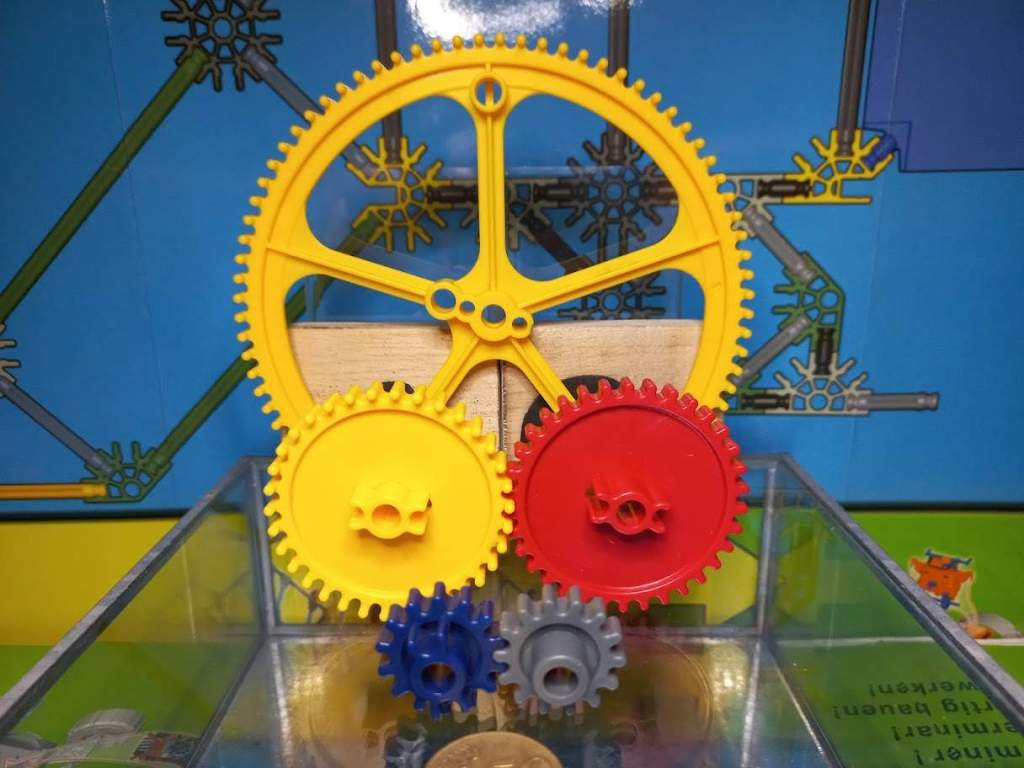
K’NEX gears and chains add mechanical movement to a construction. Gears can transfer rotation directly between axles, change the direction of movement, and change speed and torque. Chain makes it possible to transfer movement over a greater distance.
Most of the gears on this page belong to the Classic K’NEX system. A smaller number are designed for Micro K’NEX or help connect Classic and Micro mechanisms.
To make identification easier, the main Classic gears are shown approximately from small to large. Classic and Micro parts are kept separate wherever possible.
Part numbers, colors and sometimes specifications can vary between production periods. Where different sources provide conflicting information, K’NEXCHANGE records the difference rather than selecting an unverified value.
Classic K’NEX small gears

The regular small Classic K’NEX gears have 14 teeth and are approximately 25 mm in diameter.
Known examples include:
| Documented name | Part no. | Teeth |
|---|---|---|
| Gear small Gold | 91313 | 14 |
| Gear small Mid Blue | 91317 | 14 |
| Gear small Mid Blue | 99117 | 14 |
| Gear small Dark Blue | 91317D | 14 |
Different part numbers can occur for similar-looking gears. They are retained separately here rather than automatically treated as identical parts.
Small gears can sometimes also be used as very small wheels or rollers. This is an alternative building use: the parts remain classified as gears.
Classic K’NEX Push-on and Snap-on gears
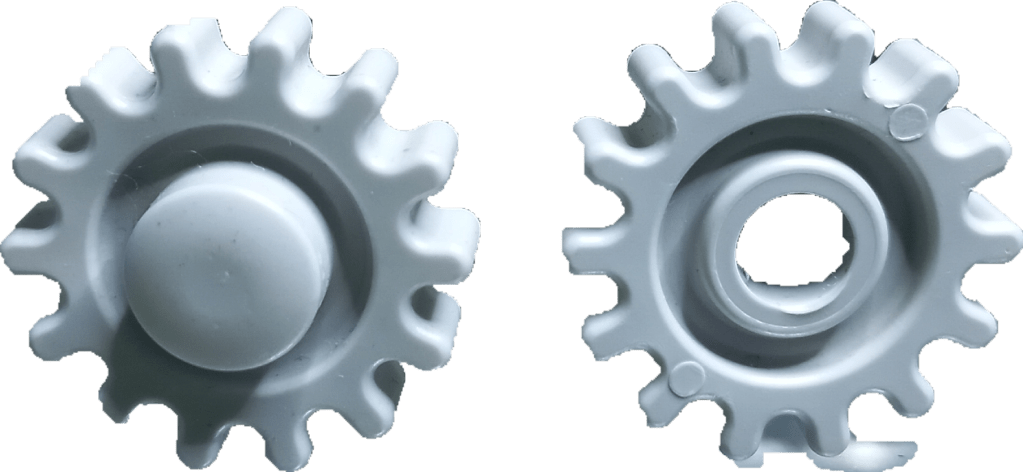
Several small gears use a different method of attachment.
| Documented name | Part no. | Teeth |
|---|---|---|
| Gear small Push-on Grey | 90988 | 14 |
| Gear small Snap-on | 91324 | 14 |
| Gear small Snap-on Black | 99119 | 14 |
Push-on and Snap-on describe how these gears attach or lock onto their axle. This makes the attachment method an important identification feature in addition to size, color and tooth count.
Classic K’NEX medium gear
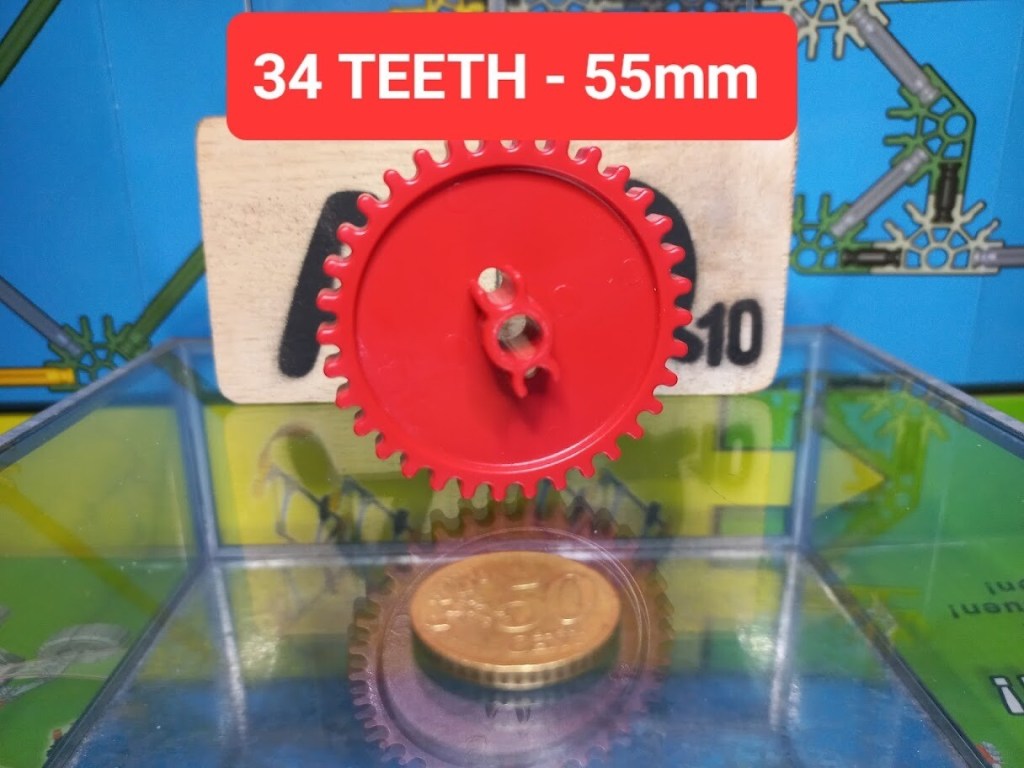
90985 — Gear medium Red
The familiar red medium gear is approximately 55 mm in diameter and has 34 teeth.
It is a regular straight gear and should not be confused with the similarly sized medium crown gears.
The distinction is important: similar diameter and tooth count do not necessarily mean that two gears have the same construction or function.
Classic K’NEX medium crown gears
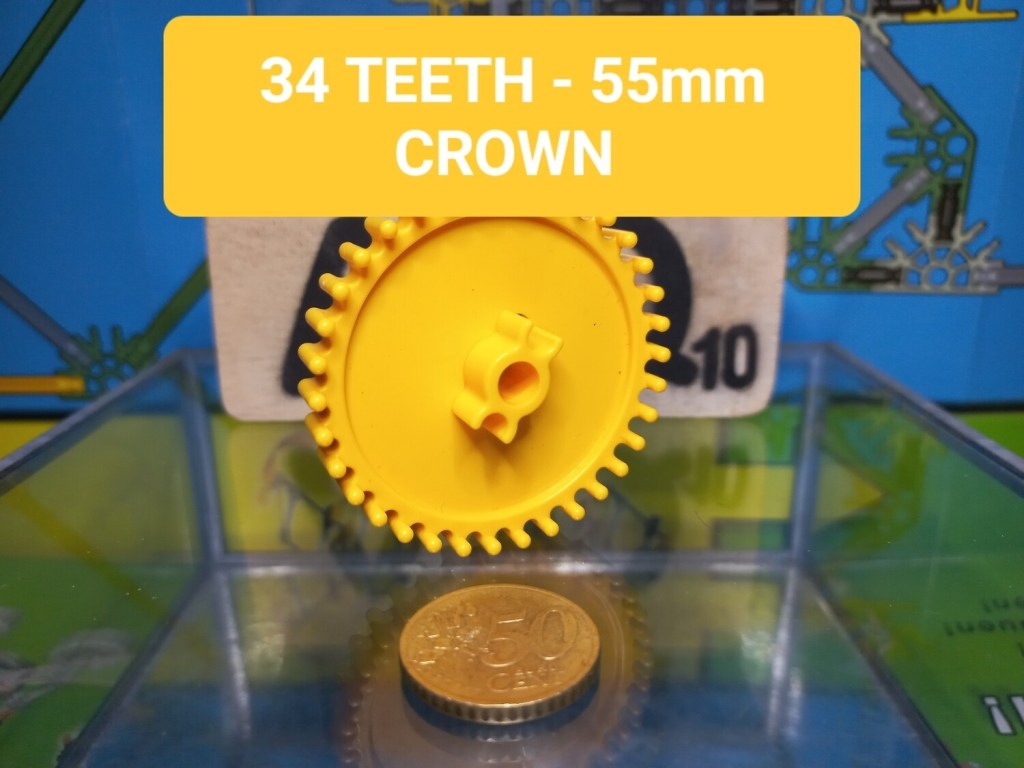
The medium crown gears are also approximately 55 mm in diameter and have 34 teeth, but their tooth arrangement differs from the regular red medium gear.
Known examples include:
| Documented name | Part no. | Teeth |
|---|---|---|
| Crown gear medium Yellow | 90993 | 34 |
| Crown gear medium Grey | 91993 | 34 |
The crown arrangement makes it possible to transfer rotation in configurations that cannot be achieved in the same way with two conventional straight gears.
Classic K’NEX partial crown gear
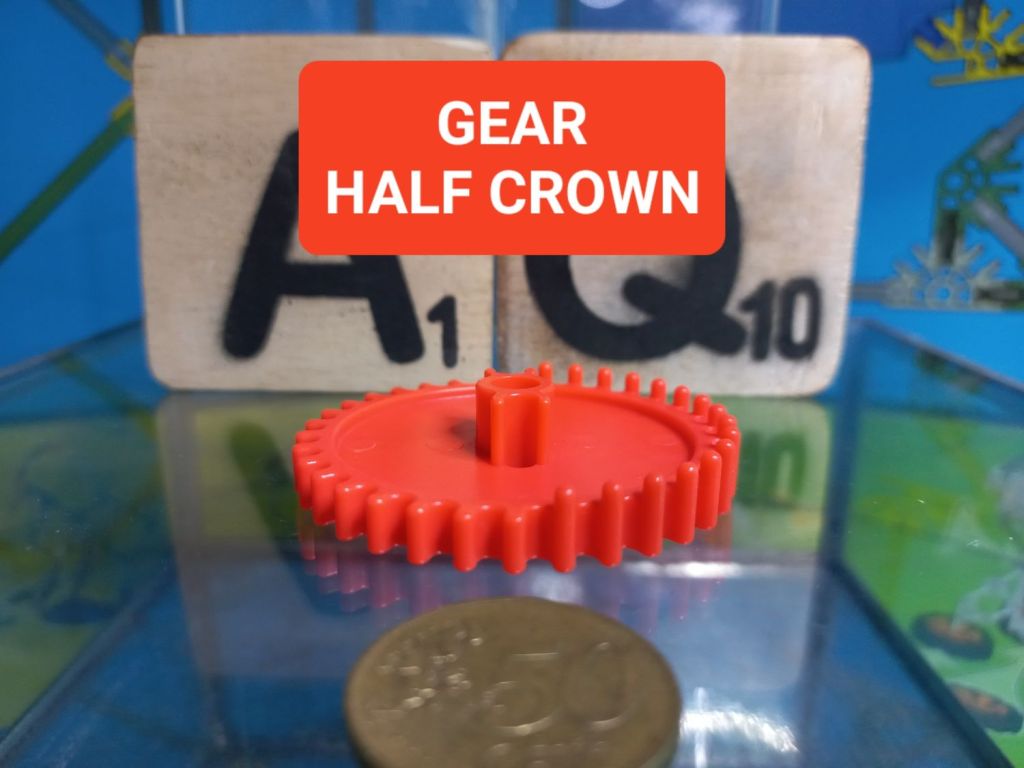
91700 — Crown gear (partial) Orange (Half Crown gear)
The orange Partial Crown gear is a distinct design. Its crown-gear engagement is present only over part of the component.
It should therefore not be treated simply as another color version of the Yellow or Gray medium crown gear.
Its unusual construction makes both shape and function more useful identification features than color alone.
Classic K’NEX large crown gears
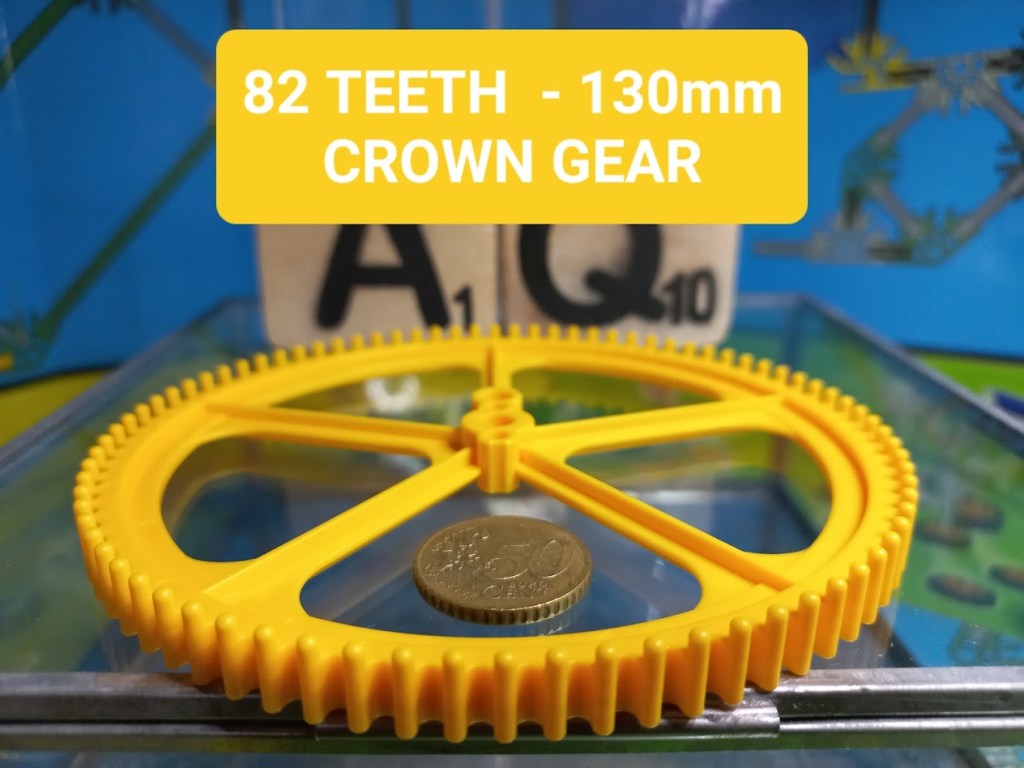

The large crown gears are approximately 130 mm in diameter. Sources report tooth counts of both 82 and 84.” Sources report different tooth counts for the large Crown gears, including 82 and 84 teeth. A published gear-ratio table is consistent with an 84-tooth version. This may indicate different versions, but further comparison of physical examples is needed before treating these as confirmed variants.
Known examples include:
| Documented name | Part no. | Teeth |
|---|---|---|
| Crown gear large Black | 90997 | 82 |
| Crown gear large Yellow | 90998 | 82 |
| Crown gear large Yellow | 91998 (Yellow version with an additional hole) | 82 |
Two part numbers are known for the Yellow Large Crown gear. 90998 and 91998 are both documented as Yellow Large Crown gears, but they are physically distinguishable. Part 91998 has an additional hole, while 90998 is the standard version. They are therefore listed as separate variants rather than treated simply as alternative part numbers for the same part.
Classic K’NEX Multi-track gear
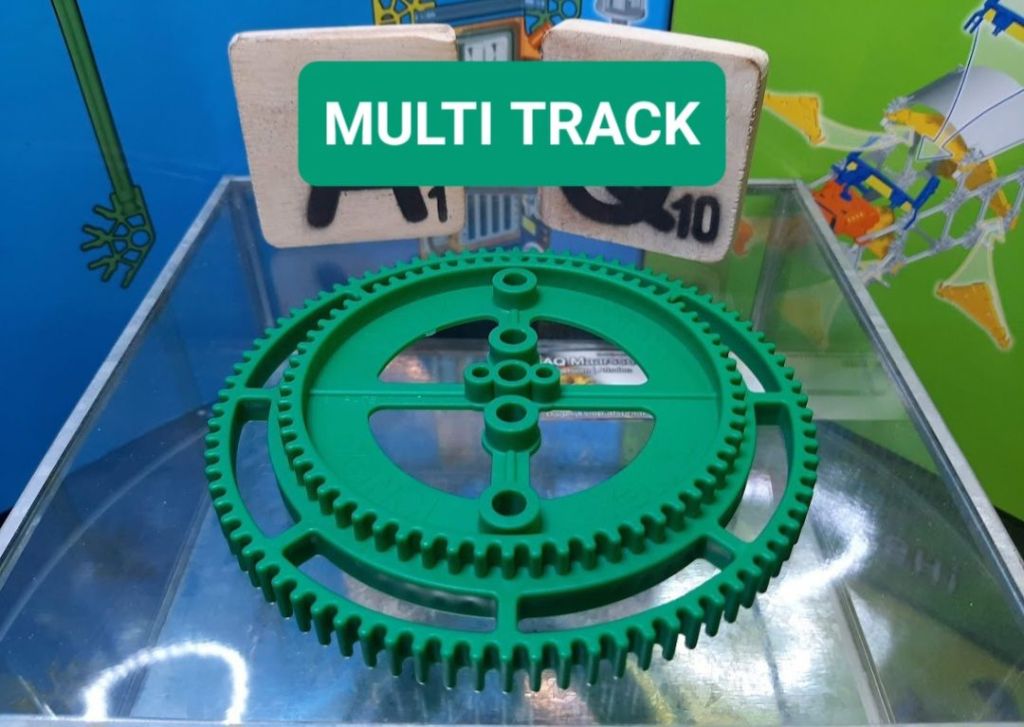
90996 — Gear Multi track Green
The large Green Multi-track gear is approximately 130 mm in diameter and differs substantially from an ordinary single-track gear. The Green Multi-track gear has several concentric toothed tracks. Published gear-ratio information distinguishes between an inner ring and an outer ring, confirming that the different tracks have different effective tooth counts and gear ratios.
Reported specifications are not fully consistent between sources. Rather than assigning a single tooth count to the entire part, K’NEXCHANGE records the individual drive tracks separately where they can be verified.
It incorporates multiple concentric drive tracks, allowing different effective drive diameters to be used on the same component.
Sources do not agree on its tooth count. Both 82 and 84 teeth have been reported.
This difference may indicate that more than one physical version of the Multi-track gear was produced. That possibility has not yet been confirmed by comparing suitable physical examples or sufficiently detailed original documentation.
K’NEXCHANGE therefore records both reported figures rather than presenting either 82 or 84 teeth as definitive.
The different concentric tracks should also be considered separately when describing the gear’s tooth counts and drive ratios.
Classic K’NEX gear for the 12V motor
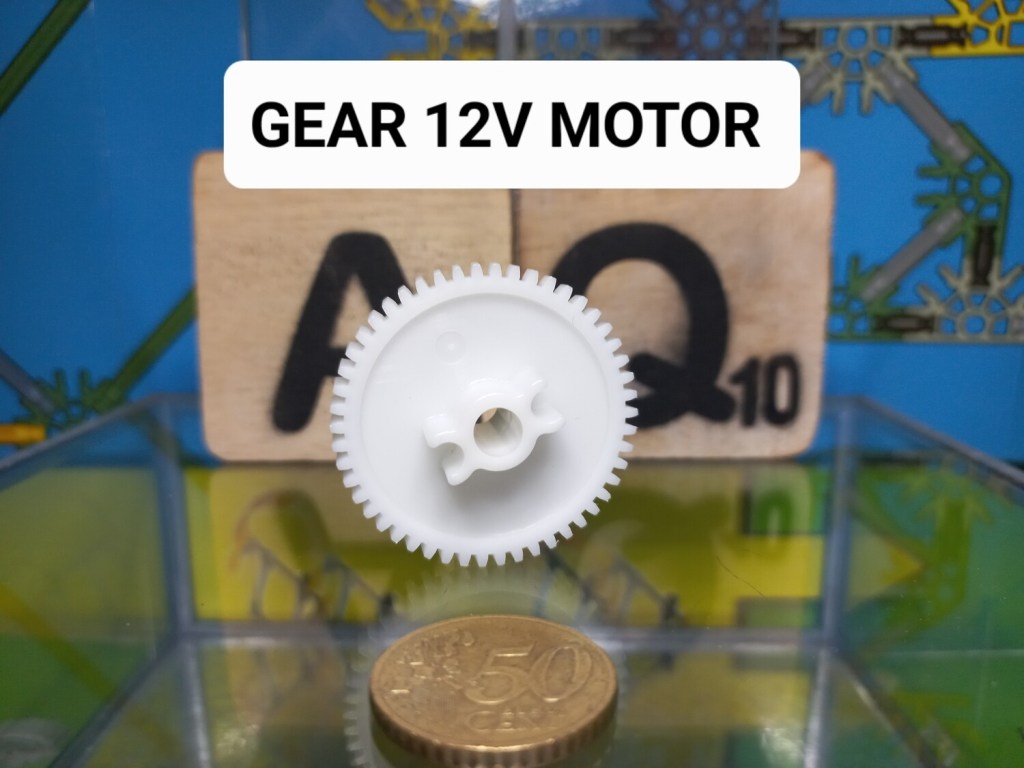
90983 — Gear White for 12V motor
This White gear is associated specifically with the K’NEX 12V motor system.
It is included here because it functions as a gear, while its relationship with the motor can also be referenced from the Motors & Power section of Special Parts.
This is an example of a part whose Family and application provide two useful ways of finding it.
Classic K’NEX large chain
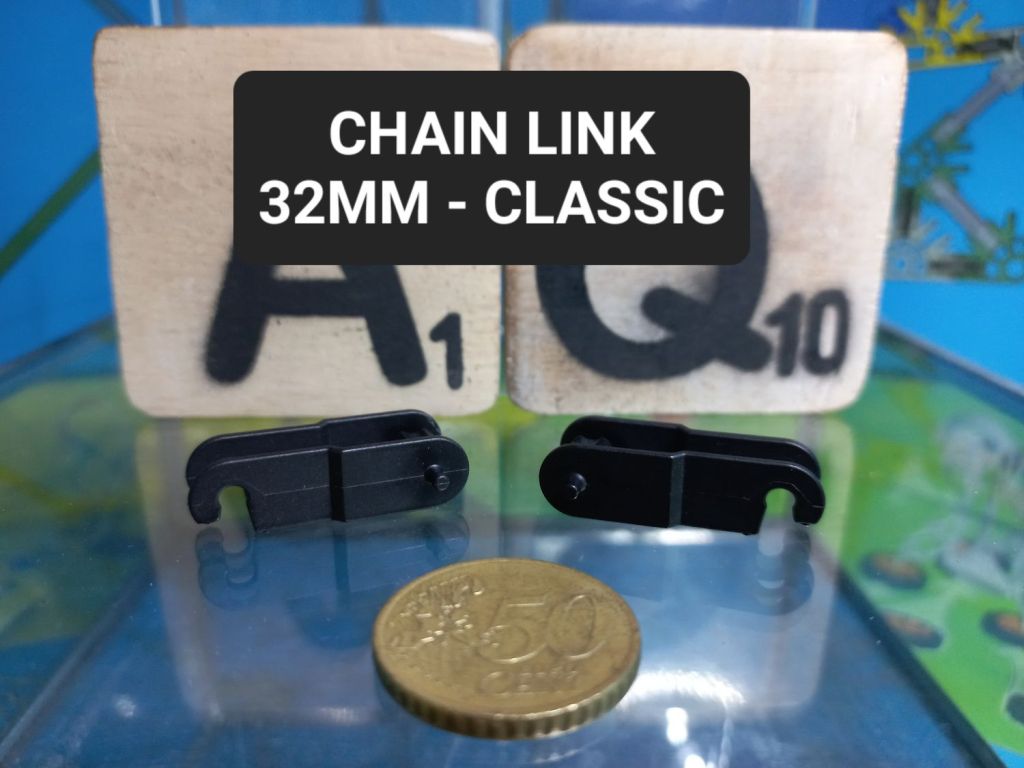
90987 — Chain link Large 32mm
The traditional larger K’NEX chain consists of individual 32 mm links that connect together to create a chain of the required length.
Unlike two conventional gears, which transfer movement by directly engaging their teeth, a chain can transfer movement between rotating components positioned farther apart.
The length of the chain can be changed simply by adding or removing links.
Sprocket gears and chain
A sprocket gear is designed to engage with chain.
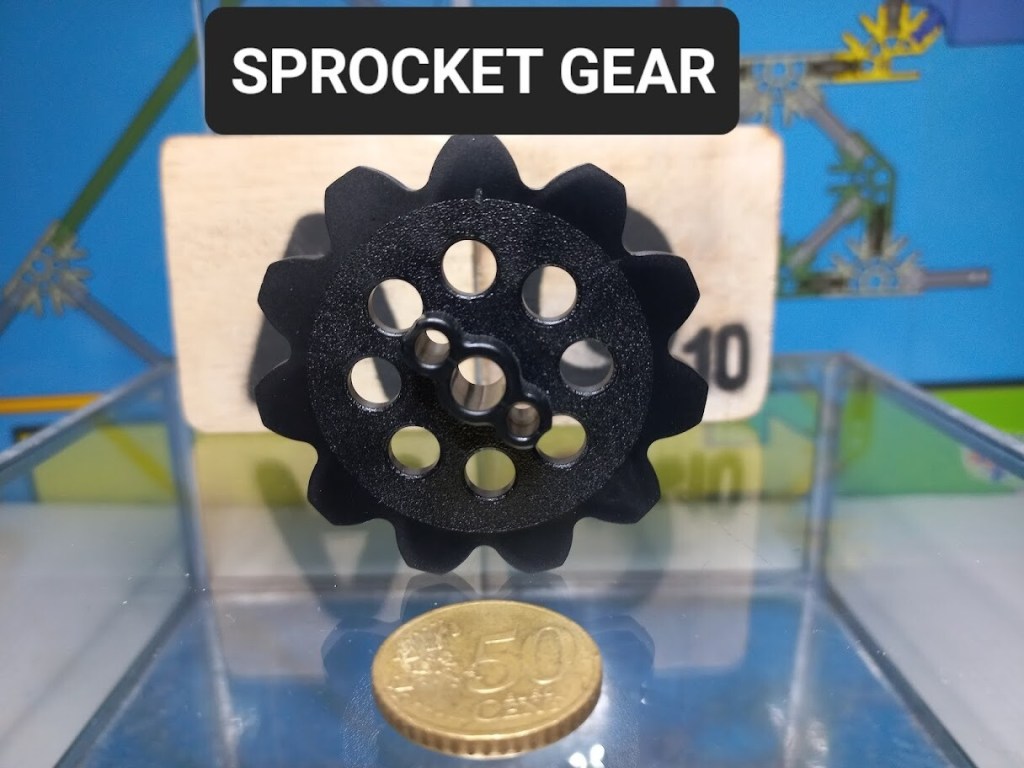
One documented example is:
517900 — Sprocket gear Black
A sprocket should not be confused with an ordinary gear. The distinction can be summarized as:
Gear → engages directly with another gear
Sprocket → engages with chain
This difference is particularly important when identifying K’NEX drive mechanisms.
Connecting Classic and Micro K’NEX
K’NEX also includes parts that make it possible to transfer mechanical movement between the larger Classic system and the smaller Micro K’NEX system.
An important example is:
509851 — Gear Grey with 6mm hole
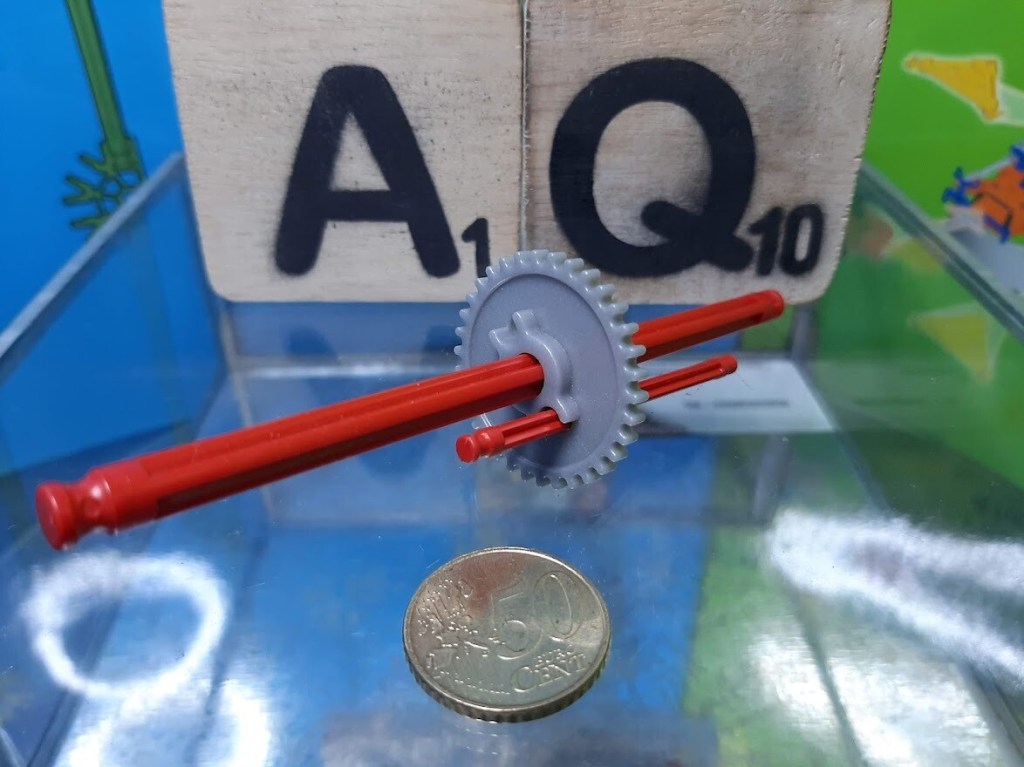
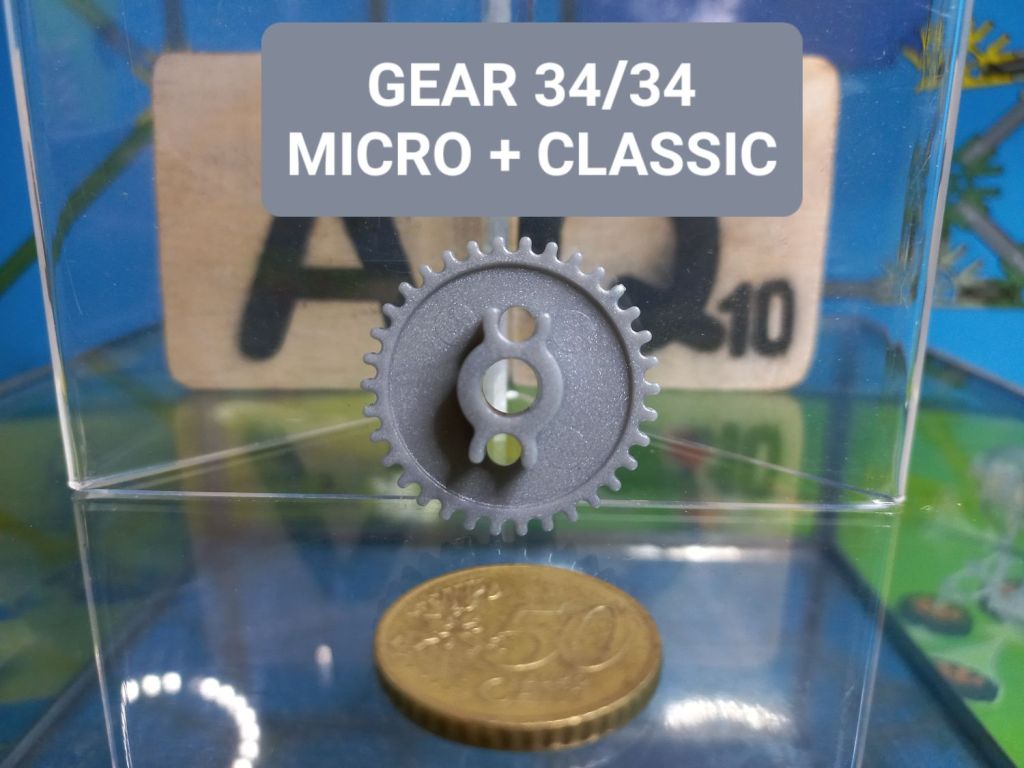
This gear is approximately 34 mm in diameter, has 34 teeth, and has a 6 mm hole suitable for a Classic K’NEX rod.
Its importance goes beyond its size. It can mesh with a smaller Micro K’NEX gear, allowing rotation to be transferred between the two systems.
For this reason, 509851 is best understood as a Classic/Micro transition gear rather than being hidden among either the regular Classic or Micro gears.
Micro K’NEX gear
A corresponding Micro K’NEX gear is:
513130 — MICRO K’NEX Gear small Blue metallic
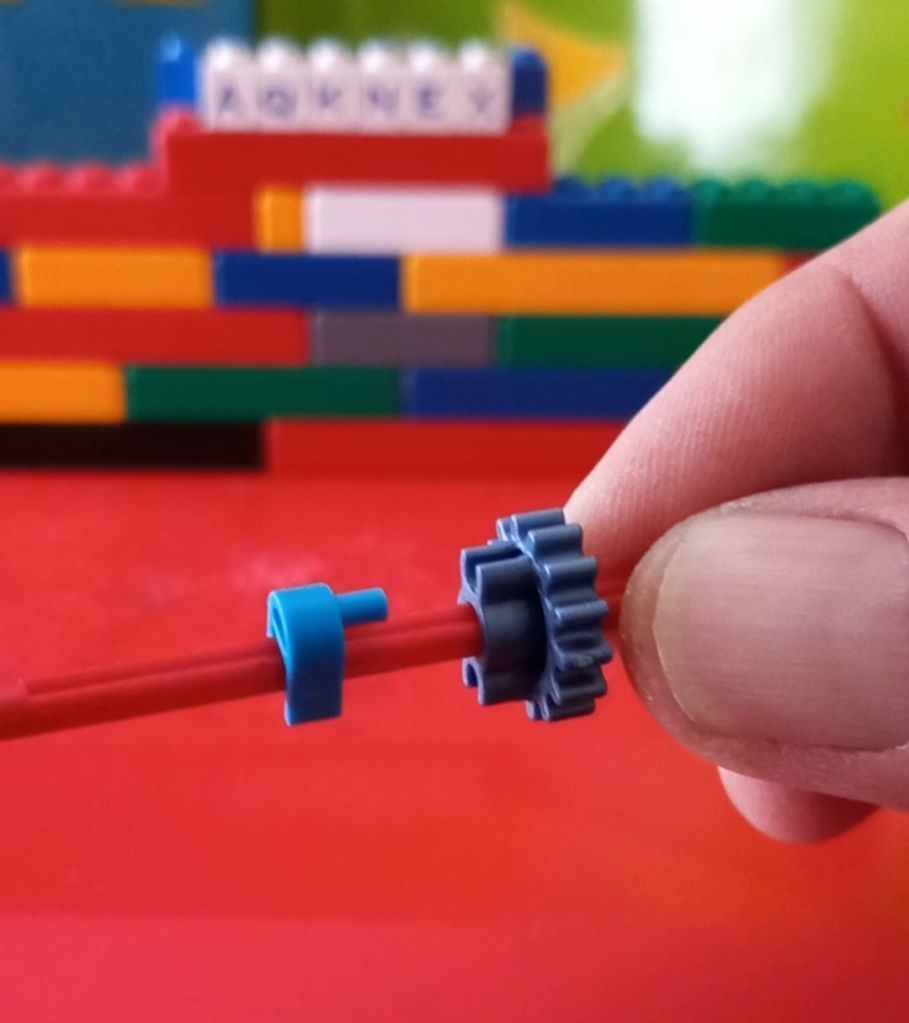
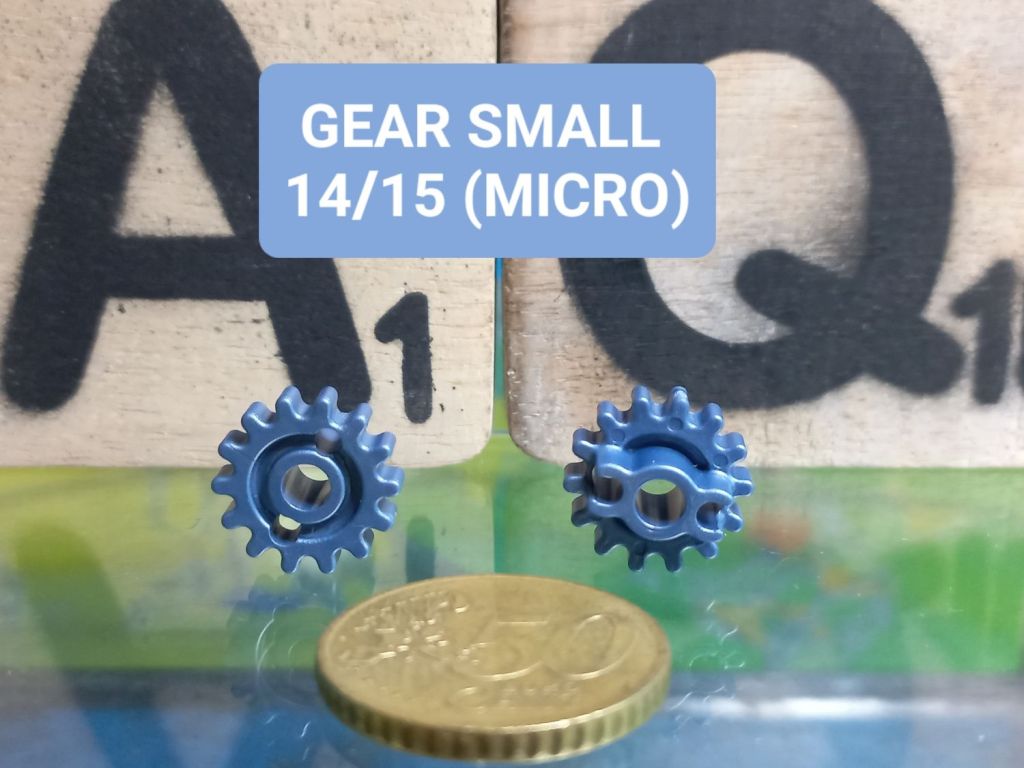
This gear is approximately 15 mm in diameter, has 14 teeth, and is designed around the smaller Micro K’NEX rod system.
It can mesh with the larger:
509851 — Gear Grey with 6mm hole
Together they provide a mechanical connection between the two K’NEX systems:
Classic axle → 509851 transition gear ↔ 513130 Micro gear → Micro axle
This is one reason why some K’NEX Special Parts cannot be understood completely by looking at Classic or Micro parts in isolation.
Micro-related small chain
509870 — Chain link Small 20mm
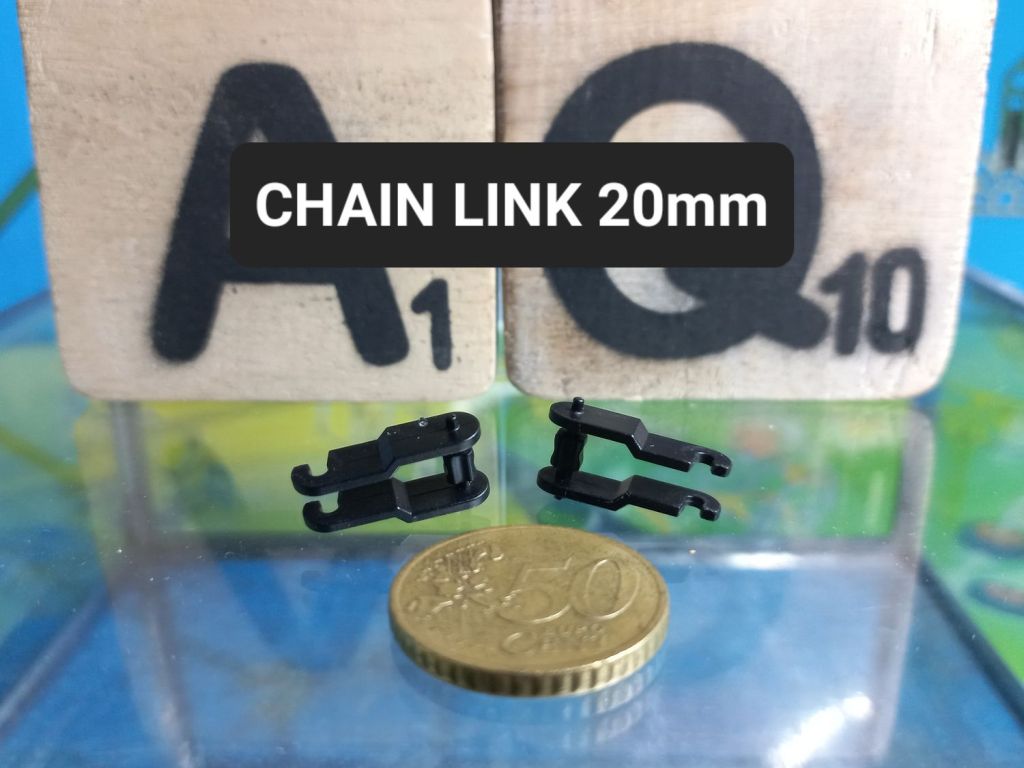
The smaller K’NEX chain uses individual 20 mm links.
It is particularly associated with mechanisms using Micro K’NEX, including coaster mechanisms.
For identification, K’NEXCHANGE uses the documented description Small 20 mm chain rather than simply renaming it “Micro chain.” This keeps the documented part identity separate from the systems and applications in which it is used.
The 20 mm chain should not be confused with:
90987 — Chain link Large 32mm
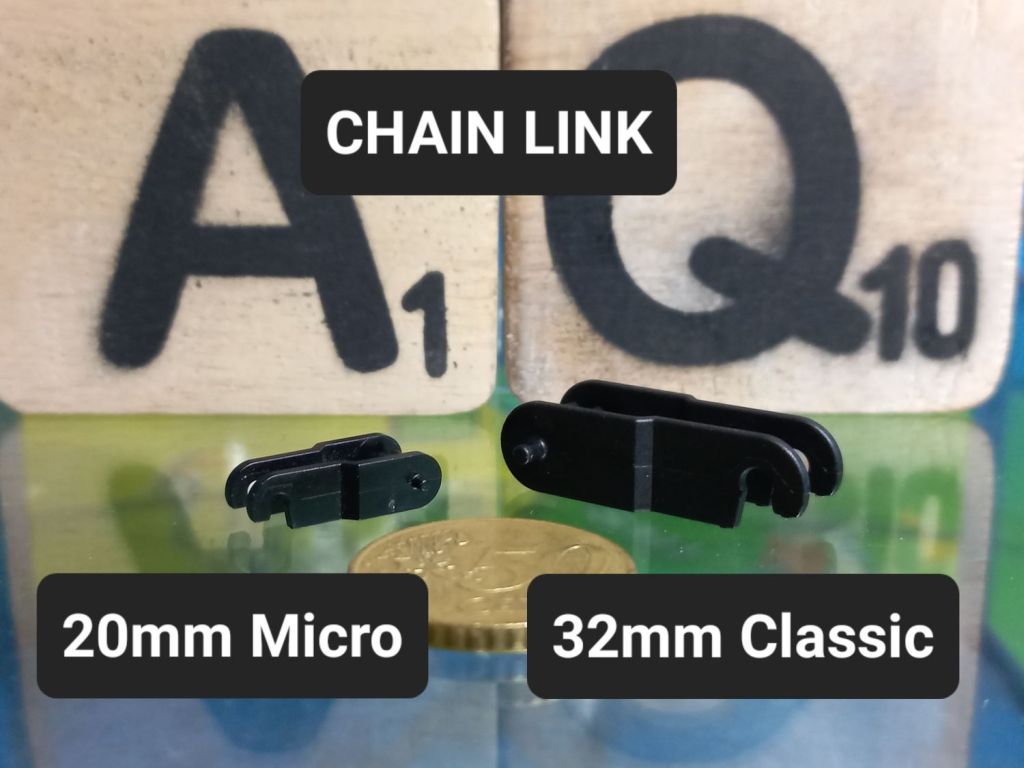
The difference in link size is immediately important when identifying an incomplete chain mechanism.
MICRO K’NEX Chain Guide
850200 — MICRO K’NEX Chain Guide
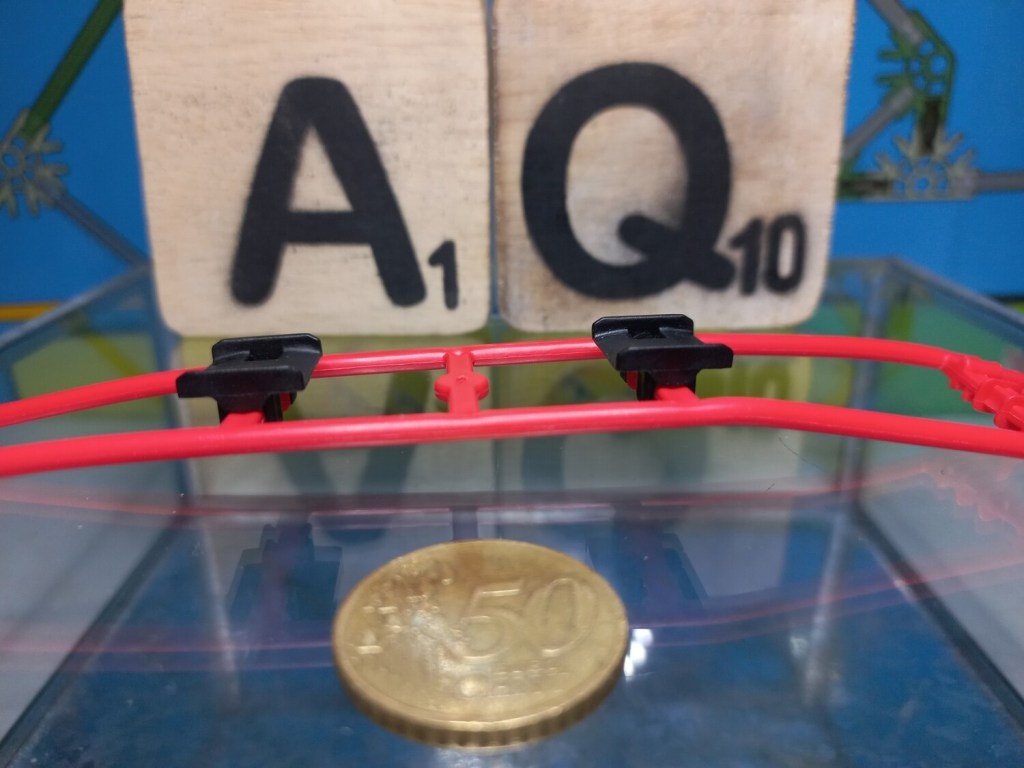
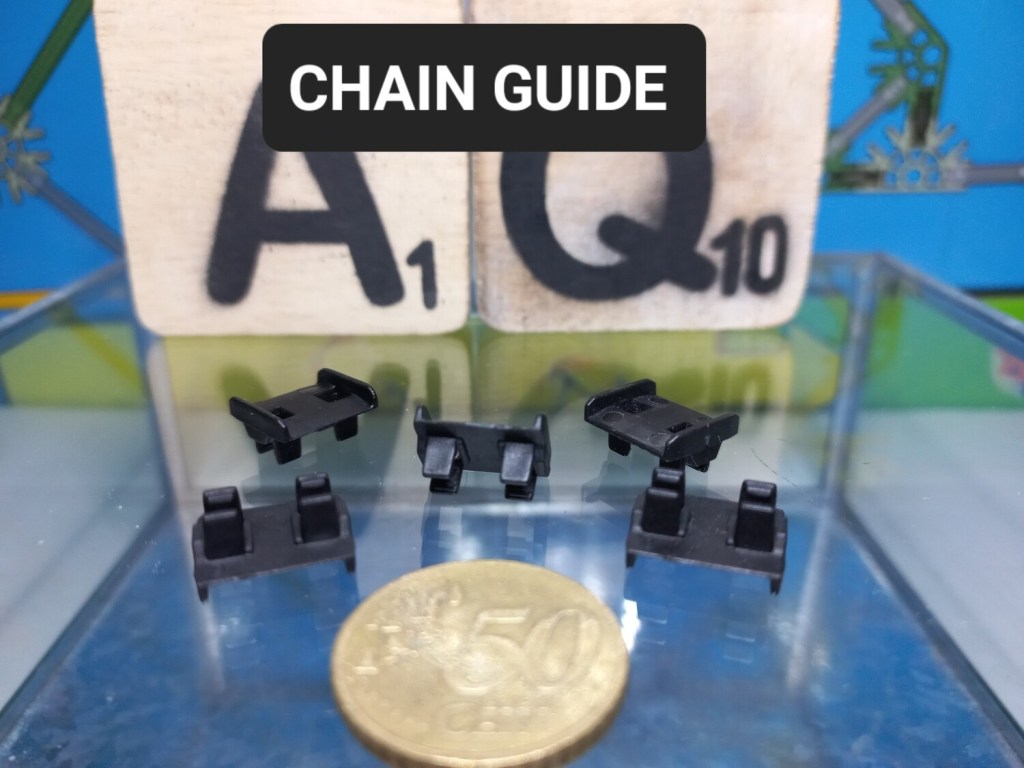
The Chain Guide is explicitly a Micro K’NEX component.
It fits onto a sprocket gear and can be attached to Micro K’NEX track. This allows it to guide the small chain where the chain-drive mechanism interacts with the Micro track system.
The functional relationship can be represented as:
Sprocket gear → 20 mm chain → Micro K’NEX Chain Guide → Micro track
The Chain Guide is not itself a chain link or gear. It is a specialized component that helps the chain-drive system operate with the Micro track.
How gears change speed and torque
Gear size and tooth count affect the relationship between the rotational speeds of connected axles.
When a smaller gear drives a larger gear, the larger gear normally rotates more slowly while providing greater torque.
When a larger gear drives a smaller gear, the smaller gear rotates faster.
For calculating this relationship, tooth count is more useful than color or approximate diameter.
For example, a 14-tooth gear driving a 34-tooth gear gives a ratio based on:
34 ÷ 14 ≈ 2.43
The 34-tooth gear therefore makes approximately one revolution for every 2.43 revolutions of the 14-tooth driving gear, ignoring losses and other gears in the mechanism.
Changing which gear drives which reverses the speed/torque relationship.
Crown gears and direction changes
Crown gears make it possible to arrange gears differently from a conventional pair of straight gears.
This can be useful when rotation needs to be transferred between axles positioned at an angle to one another.
K’NEX provides several crown-gear designs, including:
- Medium Crown gear
- Partial Crown gear
- Large Crown gear
These should be identified by their physical tooth arrangement rather than by color alone.
Chain and distance
A row of conventional gears can transfer movement from one location to another, but every gear must remain correctly positioned against the next.
Chain provides another solution.
A sprocket can drive a chain, which transfers movement to another suitable rotating component farther away. The distance can be adjusted by changing the number of chain links and the positions of the rotating components.
This makes chain particularly useful in larger moving models and coaster mechanisms.
Gears used as wheels
K’NEX parts can often perform more than one function.
The small 14-tooth gears can, for example, be used as small wheels or rollers when their shape and size suit a model.
They nevertheless remain Gears in the Parts classification.
This follows the same principle used elsewhere in K’NEXCHANGE: an alternative building use does not necessarily change what the physical part is.
Quick reference — Classic K’NEX
| Type | Part no. | Approx. size / teeth |
|---|---|---|
| Small gear | 91313, 91317, 99117, 91317D | ±25 mm / 14 teeth |
| Push-on gear | 90988 | ±25 mm / 14 teeth |
| Snap-on gear | 91324, 99119 | ±25 mm / 14 teeth |
| Medium gear | 90985 | ±55 mm / 34 teeth |
| Medium crown gear | 90993, 91993 | ±55 mm / 34 teeth |
| Partial crown gear | 91700 | Medium size class |
| Large crown gear | 90997, 90998, 91998 | ±130 mm / 82 teeth |
| Multi-track gear | 90996 | ±130 mm / 82 or 84 reported |
| 12V motor gear | 90983 | Special motor application |
| Large chain | 90987 | 32 mm link |
Quick reference — Classic/Micro transition
| Part | Part no. | Function |
|---|---|---|
| Gear Grey with 6mm hole | 509851 | Classic/Micro transition gear |
| MICRO gear small Blue metallic | 513130 | Micro gear that can mesh with 509851 |
| Sprocket gear Black | 517900 | Chain drive / cross-system mechanical application |
Quick reference — Micro-related chain parts
| Part | Part no. | Function |
|---|---|---|
| Chain link Small 20mm | 509870 | Small chain used particularly in Micro mechanisms |
| MICRO K’NEX Chain Guide | 850200 | Fits a sprocket and attaches to Micro track |
About this overview
K’NEX gears and chain have been produced over many years. Part numbers, colors and applications can vary between sets and production periods.
K’NEXCHANGE therefore identifies parts using a combination of:
- documented part number;
- physical construction;
- diameter;
- tooth count;
- axle or hole size;
- attachment method;
- K’NEX system;
- and known function.
Color is useful for recognizing many traditional K’NEX gears, but it should not be treated as the sole identifier.
Where reliable sources disagree, the difference is retained. For example, both 82 and 84 teeth have been reported for the Green Multi-track gear 90996. This could indicate different versions, but K’NEXCHANGE does not present that explanation as confirmed until sufficient physical or documentary evidence is available.
Parts that connect Classic and Micro K’NEX are identified explicitly as transition or cross-system parts rather than being forced into only one system.
Last checked: August 24, 2026
 K'NEXCHANGE