Updated August 2026
Looking for a specific Micro K’NEX part or part number? Use your browser’s Find function to search this page: Ctrl+F or F3 on Windows, or Command+F on Mac.
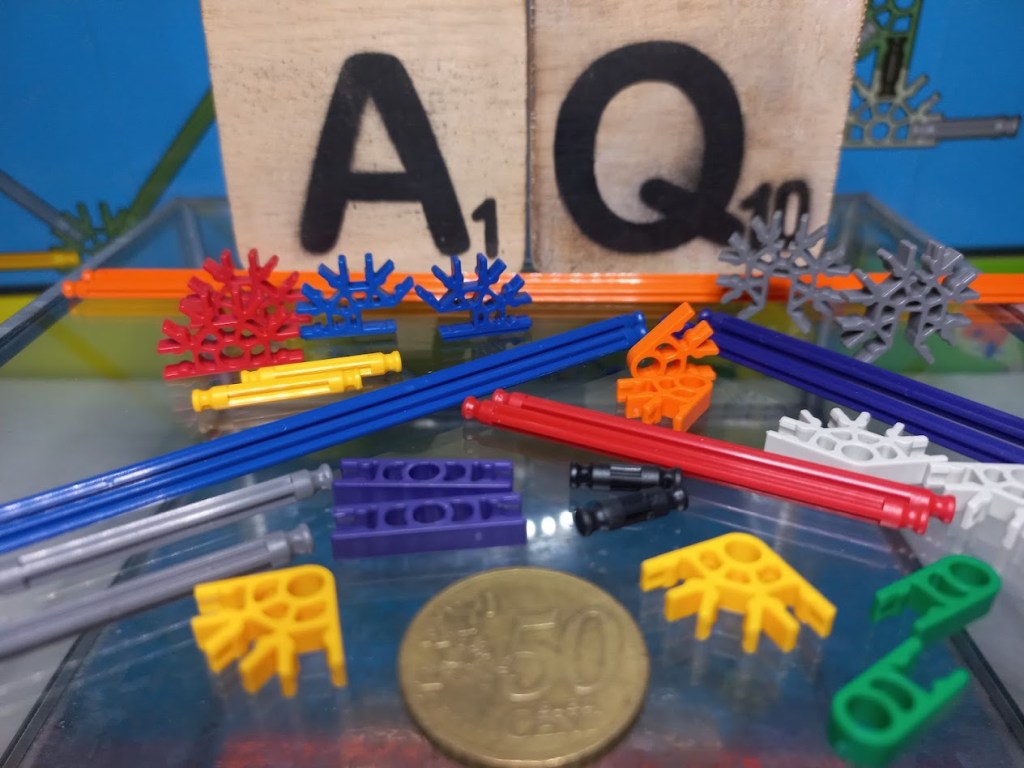
Micro K’NEX is the smaller-scale K’NEX building system. Like Classic K’NEX, it uses rods and connectors to create structures, but its components are considerably smaller and form their own construction system.
Micro K’NEX became particularly important for compact models and roller coasters, where the smaller components make it possible to create detailed structures, track layouts and mechanisms without requiring the space of an equivalent Classic K’NEX model.
Micro K’NEX and Classic K’NEX
Micro K’NEX should not be confused with small Classic K’NEX parts.
Both systems use familiar K’NEX construction principles, but their rods, connectors and other components have different dimensions. A Micro connector is therefore not simply a miniature version that can automatically be used with a Classic rod.
Classic and Micro K’NEX can, however, be combined deliberately. Transition rods, adapters and related components were designed to provide connections between the two scales, and some K’NEX sets use both systems in the same model.
When identifying an unfamiliar small K’NEX component, first establish whether it belongs to Micro K’NEX or Classic K’NEX.
Rods
Micro K’NEX rods provide the structural lines of a model.
As with Classic K’NEX, rods can occur in different lengths, colours and versions. Micro K’NEX also includes flexible and specialised rods in addition to ordinary rigid rods.
When identifying a Micro rod, compare:
- length;
- shape and profile;
- rigid or flexible construction;
- end connections and other special features;
- colour;
- part number.
Colour can help, but should not be used as the only identifier.
See Micro K’NEX Rods for the individual rod types, sizes, colours and known part numbers.
Connectors
Micro K’NEX connectors determine the directions in which rods can be joined.
Different connector shapes provide different numbers and arrangements of connection positions. Their small size means that details such as the number of slots, their orientation and the overall connector shape are particularly important when identifying a loose part.
A useful basic principle remains:
rods provide distance; connectors provide direction
See Micro K’NEX Connectors for the individual connector types, colours and part numbers.
Clips, spacers and small connecting parts
Not every Micro K’NEX connection uses one of the main connectors.
Clips and other small components can join rods, retain moving parts, provide special connection points or help position components on an axle.
Spacers can be particularly important in mechanisms. They keep wheels, gears and other moving components in the correct position while still allowing them to rotate freely.
Because Micro parts are small, similar-looking components should be compared carefully before assuming that they are interchangeable.
Wheels and moving parts
Micro K’NEX includes wheels and other rotary or moving components for vehicles, mechanisms and specialised models.
Useful identifying characteristics can include:
- overall diameter;
- axle or rod connection;
- width;
- spoke or hub design;
- associated tyre or other component;
- part number.
Small dimensional differences can be important when a component forms part of a mechanism.
Gears and chain
Micro K’NEX gears transfer rotational movement within compact mechanisms.
Different gear forms and sizes can perform different functions. Diameter, number and arrangement of teeth, axle connection and the direction in which a gear meshes are useful identification characteristics.
Chain links can be connected to form a chain of the required length. Together with suitable gears or sprockets, chain can transfer movement between different parts of a model.
Micro and Classic chain-related components should not automatically be assumed to be the same size.
Track and roller-coaster parts
Roller coasters are one of the most recognisable applications of Micro K’NEX.
Micro coaster systems can include specialised track, track supports, cars and components for lifts, launches and other mechanisms.
Different coaster systems and generations have existed. Similar-looking track or coaster cars are therefore not necessarily interchangeable.
When identifying Micro coaster parts, compare:
- track profile;
- length and curvature;
- connection method;
- coaster-car design;
- pins or other lift-related features;
- the set or instructions in which the part appears.
Original building instructions can be especially useful when reconstructing a particular coaster.
Panels and specialised structural parts
Micro K’NEX is not limited to rods and connectors. Panels and other specialised structural pieces can provide surfaces, shapes, supports or model-specific functions.
Some components have a close functional equivalent in Classic K’NEX; others were developed specifically for Micro models.
Shape, connection method and documented use are therefore more useful than assuming that every Micro component must correspond directly to a Classic part.
Transition parts
Some components exist specifically to connect Micro K’NEX and Classic K’NEX.
These can include transition rods, adapters and other parts with different connection systems at opposite ends.
A transition component should therefore be identified by both systems it connects rather than being classified only as Micro or Classic on the basis of one end.
These parts are particularly useful in sets that combine the compact detail of Micro K’NEX with larger Classic K’NEX structures.
Specialised Micro K’NEX parts
Some Micro K’NEX components were developed for particular mechanisms, roller coasters, vehicles or individual product ranges.
An unfamiliar part should therefore not be dismissed as incomplete or unrelated to K’NEX simply because it does not resemble a standard rod or connector.
For specialised components, the set number and original building instructions can sometimes provide the quickest route to identification.
Part numbers, colours and variants
A Micro K’NEX component can occur in different colours or under different documented part numbers.
K’NEXCHANGE uses part numbers as an important identification tool, but a number is not assigned solely because two parts look similar.
When possible, compare:
system → family → function and shape → size → variant → colour → part number
Colour is supporting evidence. Different production periods and sets can contain alternative colours, shades or finishes without changing the basic function of a component.
Small differences in shape can be more significant than large differences in colour.
Finding a Micro K’NEX part
If you are trying to identify an unknown Micro K’NEX component:
- Check that it really belongs to Micro K’NEX rather than Classic K’NEX.
- Determine its general family: rod, connector, clip, spacer, wheel, gear, chain, track or another type.
- Examine its function and shape.
- Measure the relevant length or diameter.
- Check for a special variant, such as flexible, transition or coaster-specific.
- Compare the colour and finish.
- Search for the part number or known alternative number.
- For specialised parts, compare the component with set inventories and building instructions.
For a quick search on K’NEXCHANGE, a part number is usually the most precise starting point. If you do not know the number, begin with the component family and its shape or size.
Micro K’NEX may be smaller than Classic K’NEX, but it forms a substantial building system in its own right, with structural components, mechanisms and specialised roller-coaster parts designed around its compact scale.
 K'NEXCHANGE