K’NEX is a construction system based on rods and connectors that can be combined to create structures, vehicles, machines and moving models. Rods and connectors form the basic framework, while wheels, gears, motors, panels, tracks and many specialised components can add movement, shape and other functions.
Unlike building systems based mainly on stacking blocks, K’NEX construction often starts with a framework. Rods provide lengths and connectors join them in different directions and at different angles. Simple shapes can be combined into three-dimensional structures, while additional components make it possible to create mechanisms and moving models.
Building with K’NEX
K’NEX can be used to build a wide range of models, from simple constructions to large and technically complex structures. Vehicles can use wheels and axles, gears and pulleys can transfer movement, and motors can power parts of a model. Specialised components make it possible to build models such as roller coasters and other moving constructions.
Building with K’NEX can also provide practical experience with structures, forces, simple machines, geometry and engineering. A model can be built, tested and changed, allowing builders to discover how different choices affect the strength, movement and behaviour of a construction.
Because the parts can be disconnected and reused, builders can follow instructions supplied with a set, modify an existing model or use the same components to create their own constructions.
Three main K’NEX systems
K’NEX parts are commonly divided into three main building systems: Kid K’NEX, Classic K’NEX and Micro K’NEX. They differ mainly in scale and use their own rods, connectors and other components.
As a broad guideline, the systems can be associated with the following starting ages:
- Kid K’NEX: approximately 3+
- Classic K’NEX: approximately 5+
- Micro K’NEX: approximately 7+
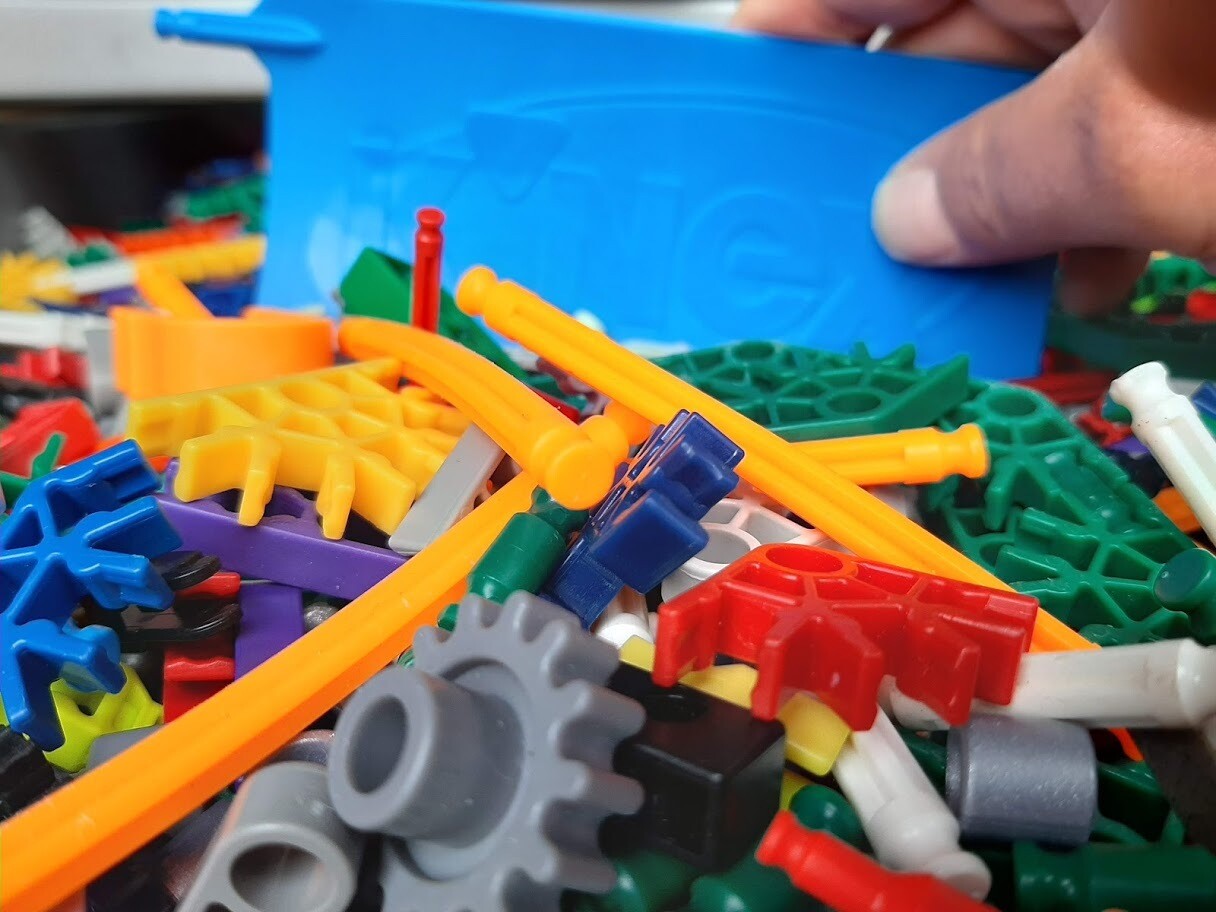
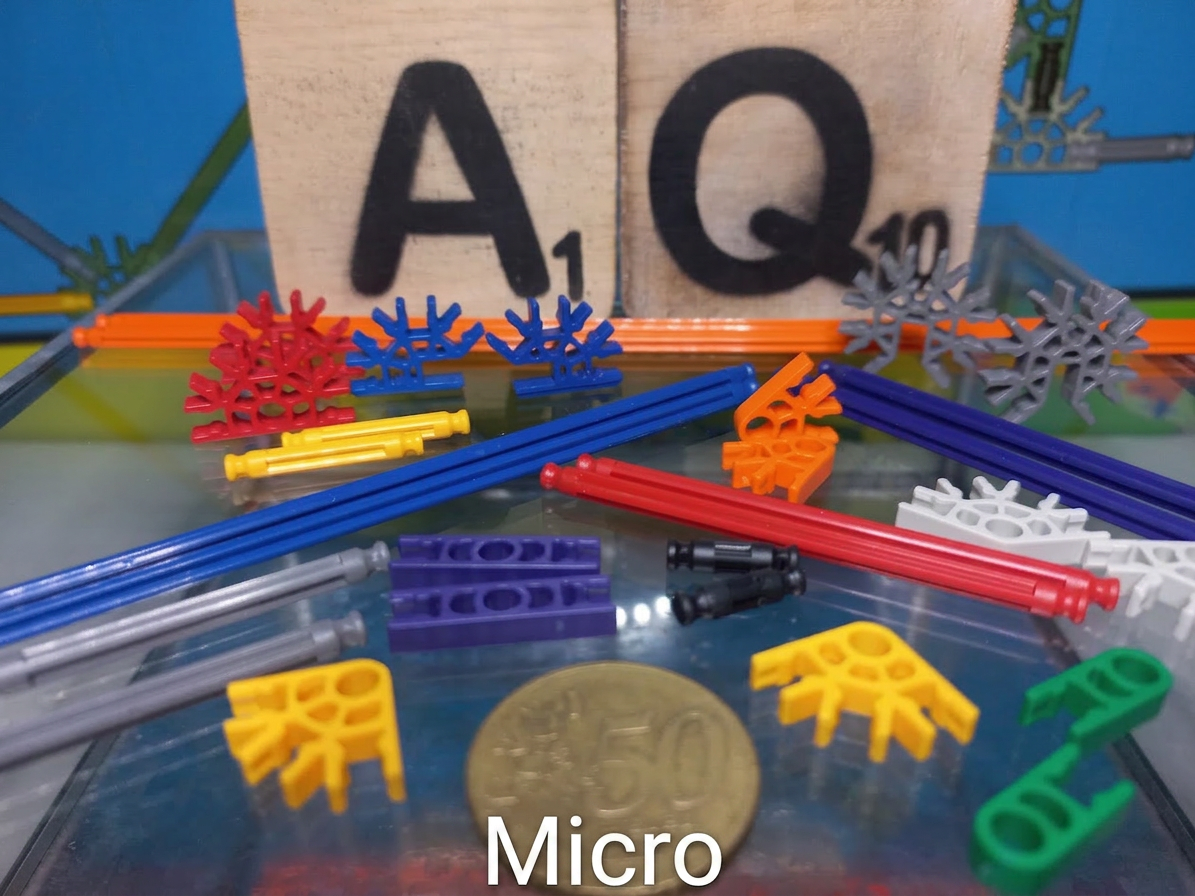

These ages are general guidelines for understanding the systems, not fixed age ratings for every K’NEX product.
The actual difficulty of a model or set can vary considerably. A simple construction using rods and connectors may be suitable for a relatively inexperienced builder, while a large model involving many parts, gears, motors or other mechanisms can be much more challenging. Individual K’NEX sets may therefore have a higher recommended age than the general guideline for the system.
Kid K’NEX — generally 3+
Kid K’NEX uses larger and chunkier rods and connectors than Classic K’NEX. The larger components are easier for small hands to join and were developed particularly for younger builders.
Kid K’NEX has its own rods and connectors as well as wheels, eyes, figures and other specialised components. It is therefore a separate building system rather than simply an enlarged version of Classic K’NEX.
The larger, easier-to-handle components can also make Kid K’NEX useful in special education and other learning environments. K’NEX has been used in educational activities for learners with special educational needs, and the larger Kid K’NEX components can be helpful where smaller construction parts are more difficult to handle. The activity and level of difficulty should always be adapted to the individual learner.
Kid K’NEX is commonly associated with children from approximately 3 years old, with educational material frequently describing it as suitable for the 3–7 age range.
Classic K’NEX — generally 5+
Classic K’NEX is the original and standard-size K’NEX system. Its construction principle is based primarily on rods and connectors. Clips, wheels, gears, pulleys, panels, motors and many specialised components greatly extend what can be built with the basic system.
Classic K’NEX can be used for anything from simple shapes and small vehicles to buildings, bridges, machines and very large constructions.
A starting age of approximately 5+ is a useful general guideline for Classic K’NEX. Educational material describes traditional K’NEX as being used from around this age. Many individual sets, however, have higher recommendations, such as 7+ or above, depending on their contents and complexity.
There is no corresponding upper age limit inherent in the building system: increasingly complex constructions can provide challenges for older children and adult builders as well.
Micro K’NEX — generally 7+
Micro K’NEX is a smaller-scale K’NEX system. Its rods and connectors have forms similar to Classic components but are manufactured at a smaller scale.
Micro K’NEX is particularly associated with roller-coaster construction. Micro track, coaster cars and related components allow detailed and relatively compact roller-coaster structures to be built.
A starting age of approximately 7+ is a useful general guideline for Micro K’NEX. As with Classic K’NEX, the actual difficulty depends on the particular model or set.
Combining systems
The three systems use different component sizes and should not be regarded as directly interchangeable.
Classic and Micro K’NEX can, however, be connected in specific ways. Transition rods and other adapter components have been produced for this purpose. Some K’NEX sets therefore contain a combination of Classic and Micro components.
This is important when identifying a K’NEX set or loose collection: the presence of Micro parts does not necessarily mean that the entire model or set belongs exclusively to the Micro system.
One building principle, many possibilities
Kid, Classic and Micro K’NEX differ in size, intended use and available components, but they share the same basic idea: reusable parts are connected to create a construction.
The possibilities range from first models made with large Kid K’NEX components to Classic structures, vehicles and machines and detailed Micro constructions. As models become larger or incorporate gears, motors and other mechanisms, the technical and building challenge can increase considerably.
This combination of reusable components, different scales and increasing levels of complexity allows K’NEX to be used for creative building as well as educational and technical activities.
Designed around geometry
K’NEX is not simply a collection of differently sized rods and connectors. The dimensions of the Classic system were designed around geometric relationships.
The distance between the centre of a connector and the point where a rod is held is fixed. Rod lengths are related to this dimension, allowing rods and connectors to form predictable geometric patterns. This makes it possible to combine simple shapes into larger two- and three-dimensional structures while maintaining consistent proportions.
K’NEX patent documentation describes this dimensional relationship as a fundamental part of the building system. It helps explain why triangles, squares, diagonals and more complex frameworks can be constructed from standard components.
 K'NEXCHANGE