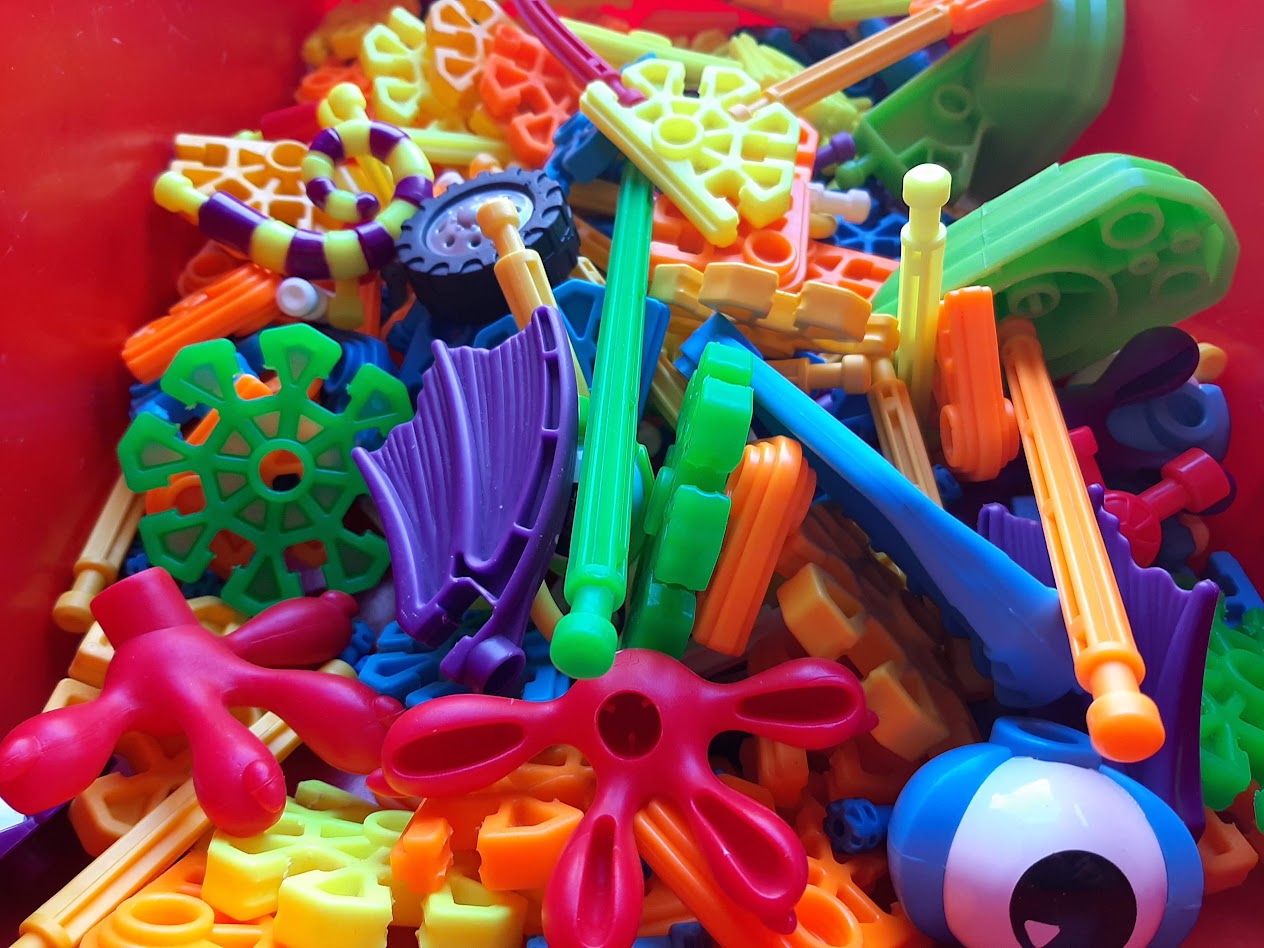

K’NEX parts can collect dust, dirt and residue after years of building, classroom use or storage. Cleaning can improve their appearance and make a mixed collection more pleasant to use, but not every K’NEX component should be treated in the same way.
Always read the original manual first and follow its instructions.
Cleaning instructions can differ between K’NEX systems, products and production periods. If the original instructions differ from the general guidance below, always follow the original instructions.
Start by Sorting the Parts
Before cleaning anything, separate the collection into different groups:
- ordinary loose plastic parts;
- painted, printed or decorated parts;
- parts with stickers;
- motors and battery holders;
- electrical components and wiring;
- mechanical assemblies;
- parts containing metal;
- unidentified or unusual components.
Remove all batteries before cleaning or inspecting battery-powered components.
Do not wash a complete mixed collection without first checking what it contains. A box of apparently ordinary K’NEX may include electrical parts, metal axles, stickers or decorated components that require different treatment.
Begin with the Least Aggressive Method
For light dust, start with a dry, soft brush or a clean cloth.
A slightly damp cloth can be sufficient for larger parts, decorated components and assembled sections that should not be immersed. This also reduces the possibility of water remaining inside openings or mechanical assemblies.
Do not force dirt from narrow openings with sharp tools. These can scratch the surface or damage connection points.
Hand-Washing Ordinary Parts
When no product-specific instructions are available, K’NEXCHANGE recommends hand-washing as a cautious general method for ordinary, undecorated and non-electrical loose plastic parts.
Use:
- cold or lukewarm water;
- a small amount of mild washing-up liquid;
- a soft cloth or soft brush;
- clean water for rinsing.
Wash a small test group first, especially when the parts are old, unusually coloured or from an unidentified K’NEX product.
Avoid solvents, bleach, abrasive cleaners and aggressive household cleaning products. They may affect the plastic, surface or colour.
This hand-washing method is general guidance from K’NEXCHANGE. It should not be interpreted as a universal cleaning instruction issued by the manufacturer.
Washing Machine or Dishwasher?
Do not place K’NEX parts in a clothes washing machine. The movement, contact with the drum and possibility of small components escaping from a bag or container create unnecessary risks.
A dishwasher should not be used unless the original instructions for the particular K’NEX product specifically allow it.
There is, however, an important official exception. Some original K’NEX Education manuals state that unpainted and undecorated Kid K’NEX parts may be washed in a normal household dishwasher. The parts must be placed in a closed basket on the upper rack.
This instruction applies specifically to the Kid K’NEX parts described in those manuals. It should not automatically be extended to:
- Classic K’NEX;
- Micro K’NEX;
- painted or decorated parts;
- parts with stickers;
- motors or battery holders;
- electrical components;
- mechanical assemblies;
- unidentified parts.
The original Kid K’NEX instructions should be consulted before using this method.
View the original K’NEX Education manual 78750 (PDF)
Painted, Printed and Decorated Parts
Paint, printed details and decorative finishes may gradually wear during use and cleaning.
An original K’NEX Education manual states that painted Kid K’NEX pieces may be hand-washed, but also warns that the paint will wear over time. This is described as normal wear rather than a product defect.
Use the gentlest practical cleaning method for these parts. Do not scrub printed faces, eyes, lettering or decorative areas aggressively.
When a part has collector value, leaving a minor mark may be preferable to risking irreversible loss of its decoration.
Parts with Stickers
Do not soak parts with stickers unless the original instructions explicitly state that this is safe.
Water and cleaning products can affect:
- the adhesive;
- the printed surface;
- transparent protective layers;
- the edges of an ageing sticker.
Use a slightly damp cloth around the sticker and avoid rubbing its edges. Dry the part immediately afterwards.
Motors, Battery Holders and Electrical Parts
Never immerse a motor, battery holder, light, wire, switch, mains adapter or other electrical component in water.
Remove batteries before cleaning. Wipe the exterior carefully with a dry or slightly damp cloth while preventing moisture from entering openings, switches or electrical contacts.
Stop using a component if it has:
- exposed or damaged wiring;
- severe corrosion;
- cracked electrical housing;
- signs of overheating;
- a burnt smell;
- liquid or residue from leaking batteries.
Do not reconnect batteries until the component is completely dry and has been checked.
Mechanical Assemblies and Metal Parts
Some K’NEX components combine plastic parts with axles, screws, springs, gears or other internal elements.
Avoid soaking an assembled mechanism when water could remain trapped inside it. Moisture that cannot easily escape may affect metal parts or internal movement.
Clean the exterior first. If further disassembly is necessary, consult the original instructions and record how the component was assembled before taking it apart.
Rinse and Dry Thoroughly
After hand-washing ordinary parts, rinse away any remaining cleaning product.
Spread the parts in a single layer on a clean towel or other suitable surface. Allow air to circulate and move the parts occasionally so that water trapped in holes, clips and connector openings can escape.
Do not close damp parts inside a storage box. Trapped moisture can cause odours, deposits and problems for any metal components accidentally included with the plastic parts.
Keep the parts away from excessive heat and prolonged direct sunlight while drying.
Inspect Before Returning Parts to Use
Cleaning is also a useful opportunity to inspect a collection.
Check for:
- cracks;
- sharp damaged edges;
- permanent deformation;
- loose decorative elements;
- badly worn connection points;
- rust or corrosion;
- exposed wires;
- battery leakage.
Remove questionable parts from children’s building collections until they have been assessed.
A Careful Method Preserves Information
Older K’NEX parts can carry information about a set, colour scheme or production period. An unusual shade or surface appearance is not necessarily dirt.
Before trying to remove a discolouration, consider whether it may be:
- an original colour variant;
- a manufacturing difference;
- an aged or faded colour;
- a special finish;
- paint or printing applied during production.
Cleaning cannot reverse every form of discolouration, and aggressive treatment may remove evidence that helps identify a historical part.
For more information, see Why Do K’NEX Parts Sometimes Have Different Colours?.
Source
K’NEX Limited Partnership Group, K’NEX Education instruction manual 78750 (2014).
The manual states that unpainted and undecorated Kid K’NEX parts may be washed in a closed basket on the upper rack of a household dishwasher. It also states that painted pieces may be hand-washed, although their paint may wear over time.
View the original K’NEX Education manual 78750 (PDF)
The linked file is an original K’NEX manufacturer manual preserved by an external archive. Its cleaning instructions concern the Kid K’NEX parts identified in that manual and are not presented as universal instructions for every K’NEX component.
Leave a Reply