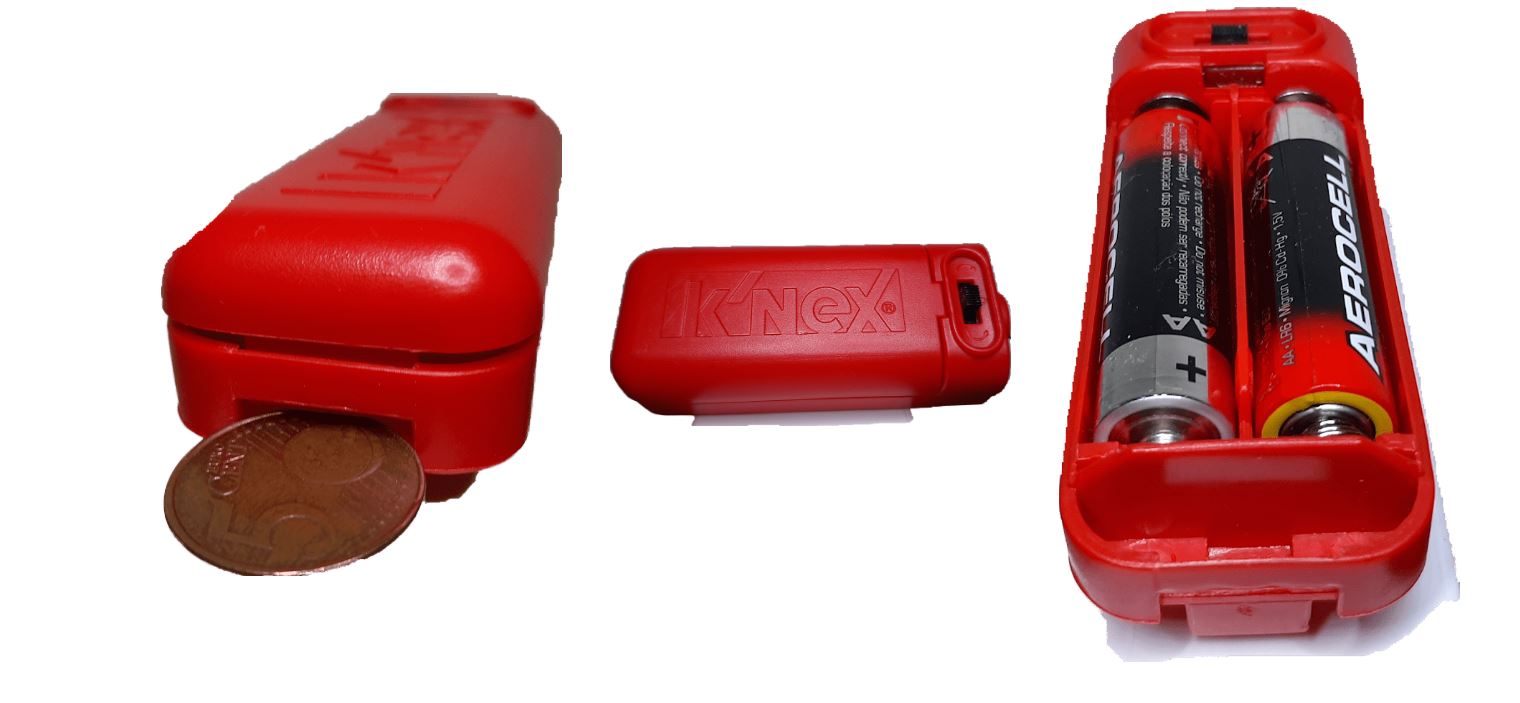

K’NEX has produced different motors, battery holders and powered components over the years. They do not all use the same batteries, opening method, connections or safety instructions.
Always read the original manual first and follow its instructions.
Use only the batteries and power supply specified for the particular motor or set. Instructions for one K’NEX motor should not automatically be applied to another.
Identify the Motor First

Before inserting batteries, cleaning a component or testing a powered model, try to identify:
- the type of motor or powered component;
- the set or product it came from;
- the required battery type;
- the correct battery orientation;
- the method for opening the battery compartment;
- any separate controller, cable or mains adapter;
- the corresponding instruction manual.
Some battery covers are secured with a screw. Others have a different opening mechanism. Use the appropriate tool and do not force the cover.
Do not rely only on the colour or external appearance of a motor. Similar-looking K’NEX components may have different internal mechanisms or power requirements.
Follow the Battery Diagram

Check the polarity markings inside the battery compartment and in the original instructions.
Insert each battery according to the indicated positive and negative positions. Installing a battery incorrectly can prevent the motor from working and may damage the component.
One current Basic Fun K’NEX manual instructs users to install two fresh AA (LR6) batteries in the motor shown in that set. This specification applies to that particular motor and should not be treated as a requirement for every K’NEX motor.
View the original K’NEX Motorized Models Building Set instructions (PDF)
Do Not Mix Batteries
Official K’NEX instructions warn users not to mix:
- new and used batteries;
- alkaline and standard carbon-zinc batteries;
- rechargeable and non-rechargeable batteries;
- different battery types.
Use only the same or an equivalent battery type recommended for the particular product.
Remove weak or exhausted batteries promptly. Do not short-circuit the battery terminals.
Remove Batteries Before Long-Term Storage
Batteries should not remain inside a K’NEX motor or battery holder during prolonged storage.
Official K’NEX instructions advise removing all batteries when the toy will not be used for a long period. This reduces the risk of leakage and damage to the contacts, wiring and housing.
Before storing a powered component:
- switch it off;
- remove the batteries;
- inspect the battery compartment;
- make sure the component is clean and dry;
- store it in a dry place;
- keep its manual or identifying information nearby.
Do not store loose batteries together with metal K’NEX components, screws or tools.
Keep Powered Components Dry
Official instructions for several powered K’NEX sets state that components should be kept free of dust and should not be immersed or used in water.
Never immerse:
- motors;
- battery holders;
- switches;
- lights;
- wired components;
- controllers;
- mains adapters;
- other electrical assemblies.
Clean the outside with a dry or slightly damp cloth. Prevent moisture from entering the battery compartment, switch, ventilation openings or connections.
Do not install batteries or connect a power supply until the component is completely dry.
Check for Battery Leakage
Inspect the battery compartment before installing new batteries, particularly when a motor has been stored for a long time.
Possible signs of leakage or corrosion include:
- white, green, blue or brown deposits;
- rust;
- damp or crystalline residue;
- discoloured contacts;
- damaged springs;
- a strong or unusual smell;
- staining or deformation of the housing.
Do not allow children to handle a leaking battery or unidentified residue.
Avoid touching leakage with bare hands. Follow the safety information supplied by the battery manufacturer and the local rules for disposing of damaged or leaking batteries.
Removing visible residue does not necessarily mean that a component is safe or fully repaired. Corrosion may have affected contacts, wires or other internal parts.
Inspect Wires, Plugs and Housings
Before operating a motor, check for:
- exposed or broken wiring;
- loose plugs;
- cracked housings;
- damaged switches;
- corroded contacts;
- missing battery covers;
- damaged screws or fasteners;
- signs of overheating.
Stop using a component that becomes unusually hot, smells burnt, produces smoke or operates intermittently when its cable is moved.
Do not bypass a switch, battery cover or other safety feature simply to make a motor run.
Check the Model Before Switching On
A motor should not be expected to overcome a construction error.
Where the design allows it, gently test the mechanism by hand before switching on the power. Check that:
- axles rotate freely;
- gears mesh correctly;
- chains are aligned;
- wheels and pulleys do not rub against the frame;
- rods and connectors do not block moving parts;
- wires remain clear of gears, wheels and axles;
- the structure is sufficiently stable.
Official K’NEX instructions warn users to keep hands, face, hair and clothing away from moving parts.
If the model does not move freely, switch it off and find the cause before trying again.
Troubleshoot One Step at a Time
If a powered model does not work, separate the possible causes.
Power: Are the correct batteries installed in the correct direction?
Battery compartment: Are the contacts clean and undamaged?
Motor: Does the motor show any sign of operation?
Transmission: Can the gears, chain, pulleys or axles move freely?
Structure: Are moving components correctly aligned?
Load: Is the mechanism asking the motor to move more weight or resistance than intended?
Change or test only one thing at a time. This makes it easier to identify the actual problem.
Different Motors Require Different Instructions
K’NEX has used battery motors, mains-powered units and other powered systems. Battery quantity, voltage, connectors, controls and gearing may differ.
Never connect an unidentified power supply merely because its plug appears to fit. An incorrect adapter can damage the component and create a safety risk.
When the original manual cannot be found, identify the motor and its original set before attempting to power or open it.
Dispose of Batteries Responsibly
Do not place batteries in a fire. Official K’NEX instructions warn that they may leak or explode and cause injury.
Used batteries and electrical products should be taken to an appropriate collection or recycling facility in accordance with local regulations. Do not place them in ordinary household waste where local rules prohibit this.
Sources
Basic Fun!, K’NEX Motorized Models Building Set 85043, instruction manual.
The manual provides instructions on battery polarity, battery types, long-term storage, keeping components away from water and avoiding battery leakage.
View the original Basic Fun K’NEX manual (PDF)
K’NEX Amusement Park Corkscrew Coaster 12434, instruction manual.
This manual contains battery-safety information, instructions to remove batteries during long periods of non-use, a warning against immersing components in water and precautions for moving parts.
View the original K’NEX Corkscrew Coaster manual (PDF)
These instructions relate to the products and motor types shown in their respective manuals. Always consult the manual belonging to the particular K’NEX motor, powered component or set.
Leave a Reply