K’NEX parts may look simple, but producing millions of rods, connectors and other components requires a highly controlled manufacturing process.
For many years, a major part of K’NEX production took place at The Rodon Group in Hatfield, Pennsylvania. Rodon specialised in high-volume plastic injection moulding and had a particularly close connection with K’NEX: both companies were part of the Glickman family business.
From plastic to K’NEX part
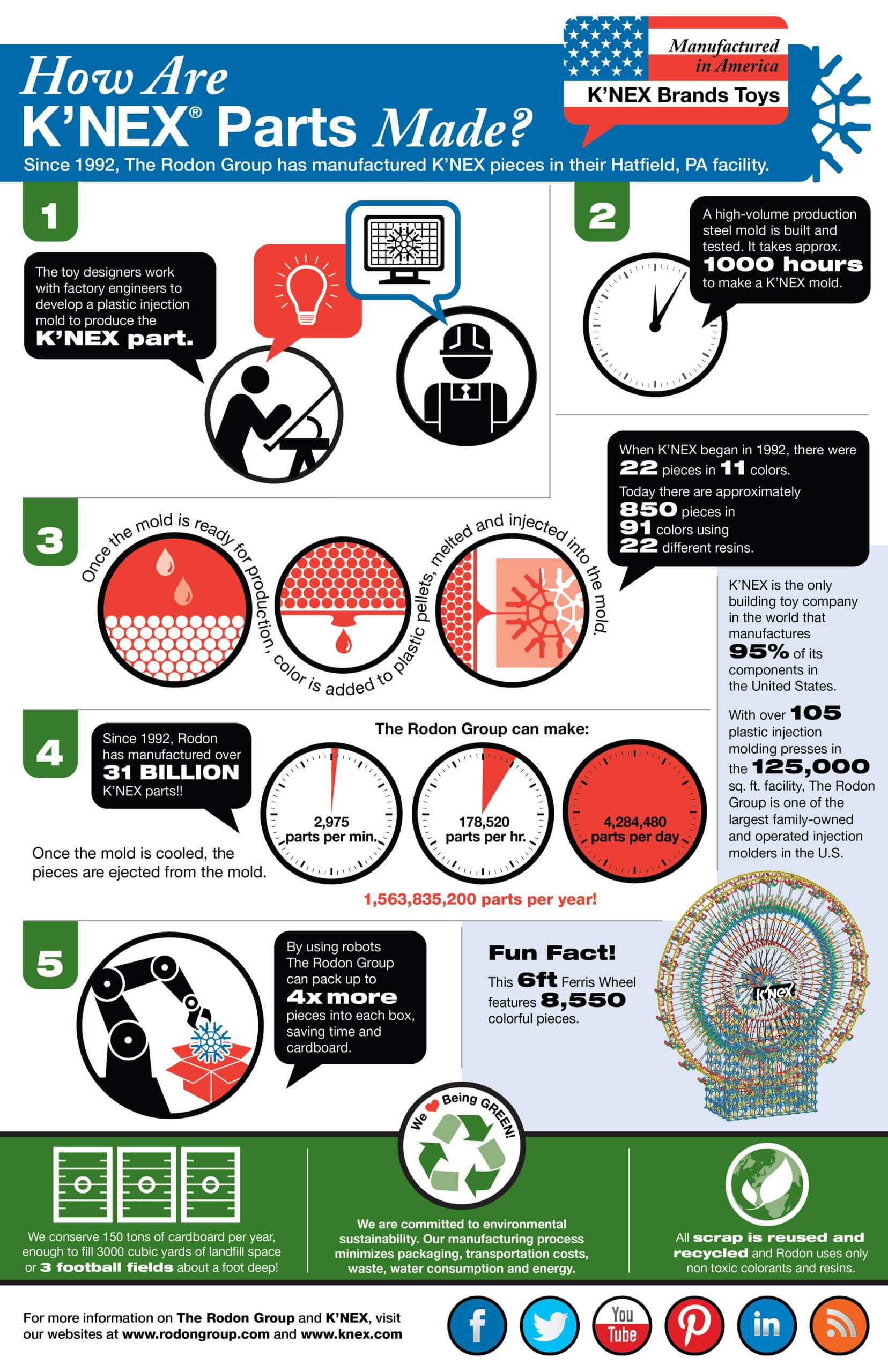
The Rodon Group produced K’NEX components using injection moulding. In this process, plastic material is heated and injected into a precisely manufactured mould. After the plastic has cooled sufficiently, the mould opens and the newly formed components can be removed.
For a construction system such as K’NEX, precision is especially important. Rods and connectors need to fit together consistently while still allowing models to be assembled, taken apart and rebuilt.
Billions of parts
The scale of production was remarkable.
The Rodon Group reported that it had manufactured more than 30 billion parts for the K’NEX construction system since production began in 1992. Later material from the company put that figure at more than 32 billion parts.
This made the factory in Hatfield an important part of the history of K’NEX.
See how K’NEX parts were manufactured
The Rodon Group created an infographic explaining how K’NEX parts were made. It provides an interesting look behind the familiar rods and connectors and at the industrial process required to manufacture them in very large quantities.
Infographic: How Are K’NEX Parts Made?

Infographic reproduced with attribution to The Rodon Group.
Leave a Reply