How a simple colour code became one of the most recognizable features of K’NEX — and why colour no longer tells the whole story.
Published August 29, 2026
If you grew up building with K’NEX, there is a good chance you still recognize the rods without measuring them.
Green is tiny. White comes next. Then blue, yellow, red and finally the long grey rod.
For many builders, those colours became so familiar that “pass me a red rod” was more useful than asking for a rod of a particular length.
That was no accident.
A colour was once a measurement
Traditional Classic K’NEX rods followed a remarkably simple system. Each standard length had its own familiar colour:
| Traditional colour | Approx. length |
|---|---|
| Green | 16 mm |
| White | 32 mm |
| Blue | 54 mm |
| Yellow | 86 mm |
| Red | 128 mm |
| Grey | 190 mm |
Instead of repeatedly measuring pieces or reading part numbers, builders could recognize the rod they needed at a glance.
K’NEX building instructions made use of this colour coding. Builders could match the pieces in their set with the colours shown in the illustrated instructions.
That was particularly clever for a construction toy designed to let children start building from pictures.
See blue rod. Find blue rod. Click it into place.
No ruler required.
Rods weren’t the only colour-coded parts
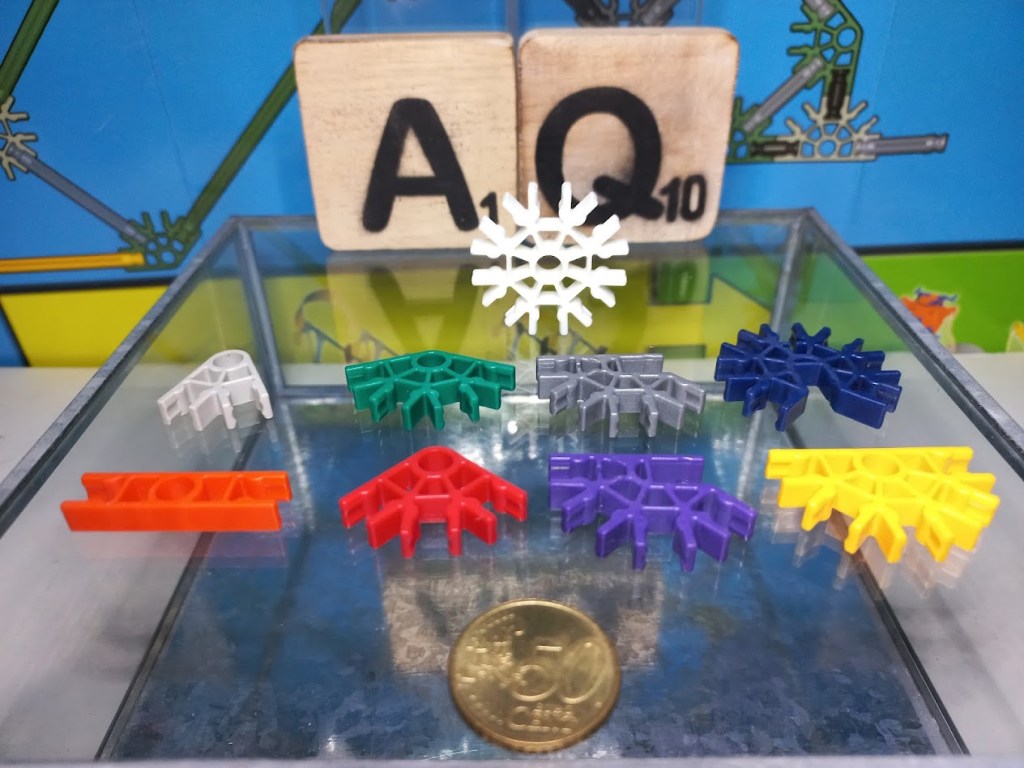
The same idea was used for the familiar Classic K’NEX connectors.
Here, colour helped identify the type of connector rather than its size.
| Traditional colour | Connector type |
|---|---|
| Dark grey | 1-way (Hole End) |
| Light grey | 2-way |
| Red | 3-way |
| Green | 4-way |
| Yellow | 5-way |
| White | 8-way |
| Purple | 4-way 3D |
| Blue | 7-way 3D |
| Orange | 2-way straight |
The purple and blue connectors were particularly distinctive because they could be connected directly to one another to create three-dimensional connections.
This meant that colour carried two different kinds of information. With traditional rods, colour helped tell you the length. With connectors, it helped tell you the shape and type of connection.
For someone following an instruction book, that was extremely convenient. You did not necessarily need to know that you were looking for a “5-way connector”. You could look at the illustration, find the familiar yellow connector and continue building.
Together, the coloured rods and connectors created something like a visual language for K’NEX.
And that language was easy to learn without ever realizing that you were learning it.
More than colourful plastic
A pile of traditional Classic K’NEX is immediately recognizable.
But it was not simply a random collection of brightly coloured plastic. Much of that colour carried information.
Underneath the colours was an equally carefully designed construction system.
The standard rod lengths are related to one another geometrically. That relationship helps builders create squares, diagonals, triangles and larger frameworks using different standard rod lengths.
The mathematics deserves an educational page of its own. For everyday building, however, you did not need to understand it.
The colours did much of the identification work for you.
Then things became more colourful
There is one problem with saying that a K’NEX rod’s colour tells you its length:
Today, it doesn’t necessarily.
Over the years, K’NEX appeared in many different colour schemes. Familiar rods were produced in alternative colours for particular sets, themes, series and periods.
The traditional white rod, for example, does not always have to be white. Other standard rod lengths can likewise be found in colours very different from the ones many builders associate with them.
Metallic, fluorescent, translucent and many other variations appeared.
The same happened with connectors. Once alternative colour schemes became common, a connector’s shape became more reliable for identification than its colour.
So the old shortcut:
colour = a particular rod length or connector type
gradually became less reliable.
Colour can still be a very useful clue — but it no longer tells the whole story.
And then there are the exceptions
Colour differences were not always purely decorative.
Some rods were produced for a particular mechanical purpose rather than simply as another colour variation.
An early Roller Coaster manual, for example, specifically explains an exception involving black and grey rods. They were the same length, but the black rod was made from a special, stronger material and was intended for particular situations in the model.
Two rods could therefore have the same dimensions but differ in both colour and function.
K’NEX also introduced flexible rods and other specialized components. That makes identification more interesting than simply matching a colour to a length.
For someone sorting a large mixed collection today, colour alone is no longer enough.
A useful clue for collectors
For collectors, that makes K’NEX colours more interesting rather than less.
An unexpected colour immediately raises questions.
Which set did it come from?
Was it part of a special colour scheme?
Was that colour widely used, or limited to particular products?
Is it simply a standard component in another colour, or is the part itself different?
Even pieces that appear to be the same colour can show different shades. Some differences may originate in manufacturing, while age, storage and exposure to light can also affect how plastic looks today.
Colour can therefore provide a clue about a K’NEX part’s origin or history — but it should rarely be treated as proof on its own.
The colours we still remember
Despite all the variations that followed, the traditional Classic rod sequence remains remarkably recognizable:
green · white · blue · yellow · red · grey
The familiar connector colours became part of the same visual language.
It was a simple but effective idea. Colour helped builders find the correct components without needing measurements, names or part numbers, while simultaneously giving K’NEX its distinctive appearance.
Today the K’NEX world contains far more colours than those traditional combinations suggest.
But put a traditional blue rod and a red rod in front of an experienced K’NEX builder, and chances are they already know which one is longer.
Some colour codes are difficult to forget.
 K'NEXCHANGE
Plaats een reactie