For a time, K’NEX did much more than rods and connectors. It developed an entire family of bricks — and some surprisingly clever ways of connecting them to the K’NEX system.
Published August 29, 2026
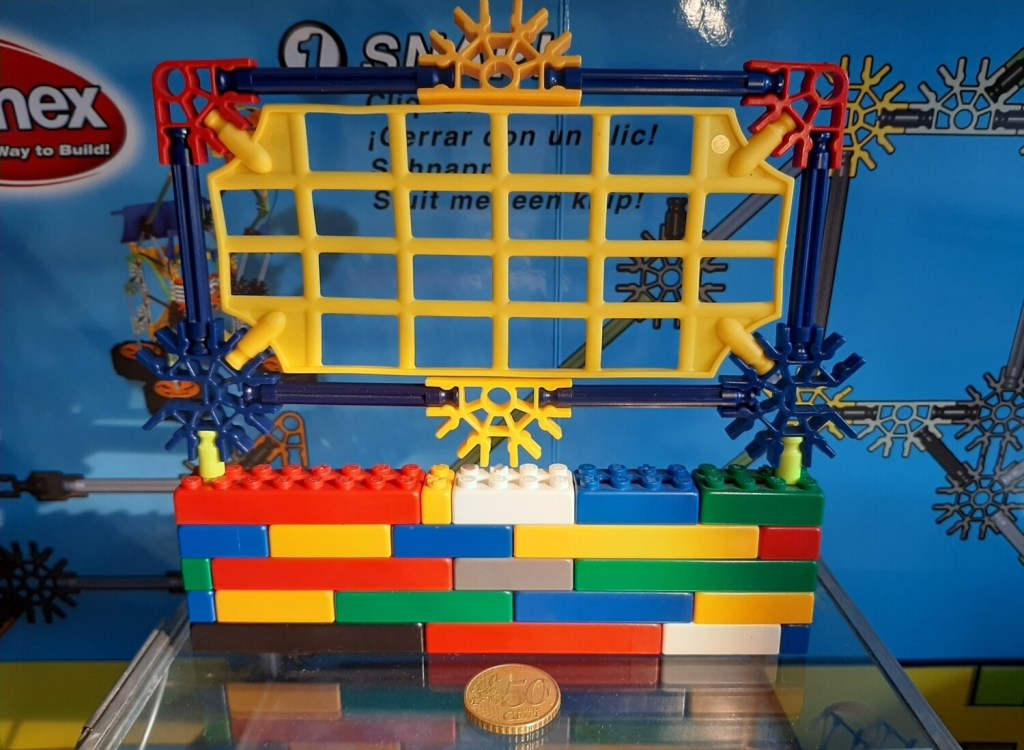
For most builders, K’NEX means rods and connectors.
That makes it slightly surprising to discover a pile of K’NEX parts that looks, at first glance, much more like a conventional brick construction set.
K’NEX made 1×1 bricks, 2×4 bricks, long bricks, flat plates, wedges, baseplates and many other brick-shaped components. There were even specialized bricks designed to connect directly with rods and connectors.
And this was not just a brief experiment with a handful of parts.
For a period, K’NEX Bricks developed into a surprisingly extensive construction system of their own.
So where did they come from — and whatever happened to them?
K’NEX didn’t begin with bricks
The original K’NEX system was built around a very different idea.
Instead of stacking blocks, builders connected rods to circular connectors. The carefully related rod lengths made it possible to create triangles, squares, diagonals and large three-dimensional frameworks.
Bricks worked differently. They were based on a regular grid of studs.
That difference became important when K’NEX decided to bring the two systems together.
The patent record shows that this was a serious engineering project rather than simply a matter of producing some K’NEX-branded building blocks.
Work on interfacing block-type construction toys with the K’NEX rod-and-connector system was already underway by 2005. Further patent applications followed in 2006, including a complete brick-based construction toy system.
There was a fundamental problem to solve.
The geometry didn’t match.
Two construction systems, two different grids
Conventional building bricks use studs spaced on a regular 8 mm grid.
Classic K’NEX had been designed years earlier according to the geometry of its rods and connectors, with no need to match that grid.
Put the two systems together and their connection points do not naturally line up.
K’NEX engineers developed some ingenious solutions.
Special bricks could contain holes or sockets between their studs. Adapters fitted into those openings and provided a connection for K’NEX components.
An even more sophisticated solution used an offset adapter. Its K’NEX connection was deliberately positioned slightly away from the center of the brick connection below it. Turning adapters in different directions compensated for the difference between the two construction grids.
In other words, the little adapters were doing something rather clever:
they were translating one construction geometry into another.
The system was designed to work with both Classic and Micro K’NEX.
How to recognize a K’NEX Brick
At first glance, many K’NEX Bricks look much like other studded construction bricks.
Look more closely and some reveal their K’NEX ancestry.
Certain bricks have distinctive holes between the studs. These were not decorative. They provided connection points for adapters that allowed rods and connectors to become part of the brick structure.
Other parts went further.
K’NEX produced rod-axle bricks, brick-to-connector adapters and other components specifically intended to bridge the two systems.
A brick could therefore become the foundation for a K’NEX framework, while a K’NEX mechanism could be incorporated into a brick-built model.
That made the bricks more than an imitation of an existing construction idea.
K’NEX was trying to make bricks part of K’NEX.
The family became surprisingly large
Anyone discovering K’NEX Bricks today might assume that only a few standard sizes existed.
The reality was very different.
The range included familiar rectangular bricks in numerous lengths and colours, together with thin plates and much larger building elements.
But that was only the beginning.
There were wedges, shelves, rounded and shaped pieces, left- and right-handed components, axle bricks, long-stud bricks and several kinds of adapters.
Specialized parts appeared too.
There was even a light-up brick.
The surviving variety makes an interesting point for collectors: K’NEX Bricks were not merely an accessory to the main system. At their peak, they represented a substantial family of components.
2007–2008: bricks become visible
The patent work of the mid-2000s was followed by bricks becoming increasingly visible in K’NEX products.
By 2007, K’NEX instruction material was already advertising bonus models built with bricks.
Around 2008, the idea became particularly prominent.
Sets combined Original or Classic K’NEX, Micro K’NEX and K’NEX Bricks in the same product. Bricks could provide walls, bodies and solid surfaces while rods and connectors supplied frames, mechanisms and moving structures.
K’NEX even developed products centered much more strongly on brick building.
One particularly interesting branch was Picture Bricks.
Building pictures with bricks
Picture Bricks approached construction differently again.
Rather than simply building conventional three-dimensional brick models, children could arrange coloured bricks on a building surface to create pictures. Themes included subjects such as farms, towns, carnivals and the ocean.
K’NEX and Micro K’NEX components could then add structures or movement to those brick-built scenes.
It was another attempt to combine the solid, pixel-like nature of bricks with the mechanical possibilities of K’NEX.
Picture Bricks did not become the future of the system, but today they provide an interesting snapshot of a period when K’NEX was experimenting well beyond its familiar rods and connectors.
Bricks spread into other K’NEX worlds
Brick components were not confined to one short-lived series.
They appeared in regular construction sets and educational products, and later found their way into themed and licensed sets.
Some specialized brick components can also be associated with particular K’NEX product families.
This helps explain why mixed collections can contain strange brick pieces that seem difficult to place. A wedge, axle brick or unusual shaped element may originally have had a very specific purpose in a model.
K’NEX was still using bricks in products into at least the early 2010s.
They were therefore much more than a one-season experiment.
So why did K’NEX Bricks disappear?
This is where the history becomes less certain.
It would be tempting to say that K’NEX Bricks failed because they competed with LEGO, because builders preferred traditional K’NEX, or because they were too complicated to integrate.
Those explanations sound plausible.
But without reliable evidence, they remain speculation.
What we can observe is a gradual change.
Bricks became less prominent in the K’NEX range, while the distinctive rod-and-connector systems remained central. Today, K’NEX Bricks are no longer manufactured.
There does not appear to have been one dramatic moment when K’NEX announced that the brick experiment was over.
They simply faded from the system.
An interesting challenge for collectors
That disappearance has made K’NEX Bricks more interesting today.
Standard bricks can easily disappear into boxes containing components from other construction systems. Unusual colours may be difficult to identify. Specialized bricks can be mistaken for parts from completely different toys.
The connection features provide useful clues.
Holes for K’NEX adapters, axle connections, unusual stud arrangements and specialized shapes can help identify a piece as belonging to the K’NEX brick family.
Adapters are particularly interesting because they explain why the bricks existed in the first place.
Finding an ordinary brick tells you that K’NEX once made bricks.
Finding a brick together with its K’NEX adapter tells you what the designers were actually trying to achieve.
A forgotten branch of the K’NEX family tree
Looking back, K’NEX Bricks occupy an unusual position in the history of the system.
They never replaced rods and connectors.
Instead, K’NEX tried to make two very different styles of construction coexist.
That required new bricks, new adapters and some surprisingly sophisticated engineering to reconcile two incompatible geometric systems.
The experiment ultimately disappeared from the modern K’NEX range, but it left behind a remarkably varied collection of parts.
Today those pieces are easy to overlook in a mixed box of construction toys.
Look carefully, though, and a tiny hole between a few studs may reveal something much more interesting:
a period when K’NEX tried to connect not just rods and connectors, but two entirely different ways of building.
Do you know of a later K’NEX Brick set?
K’NEX Bricks were still appearing in sets well into the 2010s, but exactly when they disappeared from new K’NEX products is not yet clear.
Do you know of a K’NEX set from 2014 or later that definitely included genuine K’NEX Bricks? If possible, include the set number, name and year — and a photo or parts list would be even better.
Your information may help us document the final years of K’NEX Bricks more accurately.
 K'NEXCHANGE
Plaats een reactie