Classic K’NEX is based on a remarkably small number of basic building elements. At the heart of the system are rods and connectors.
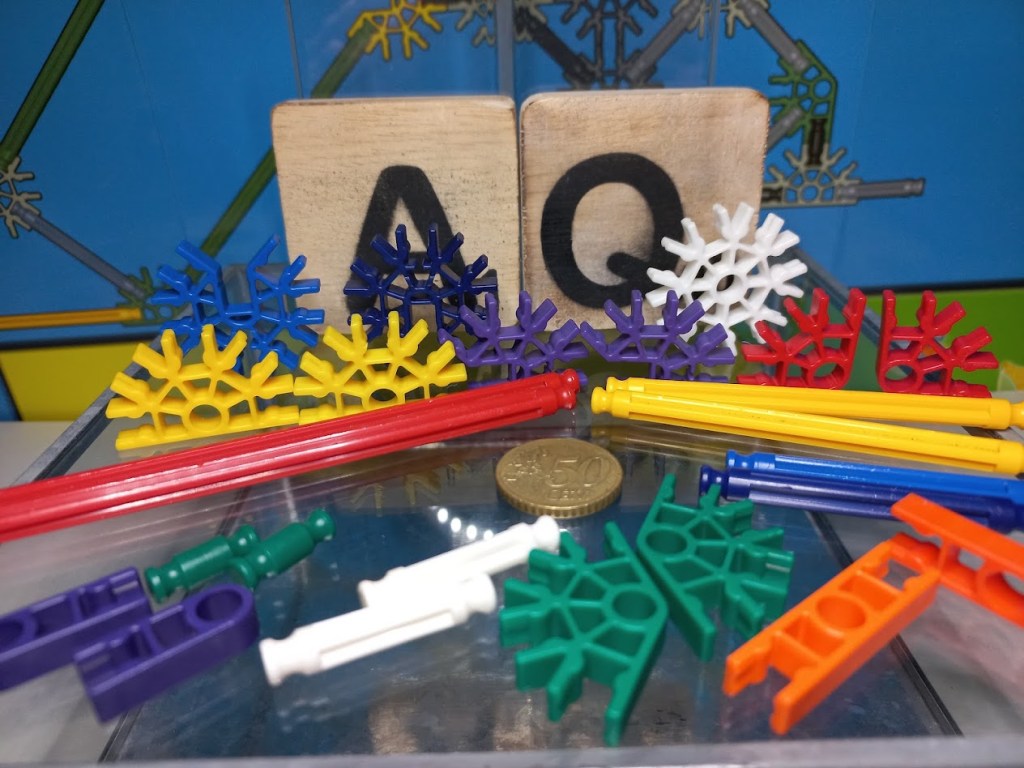
Rods provide length and structure. Connectors join the rods at fixed positions and angles. By repeatedly combining these simple elements, builders can create anything from basic shapes to large three-dimensional frameworks.
The original K’NEX patent describes essentially the same principle: structural elements are joined to hub-like connectors with sockets arranged around them. The distinctive shapes of the rod ends and connector openings allow the parts to snap together securely while remaining reusable.
Rods
Classic K’NEX uses a graduated series of standard rod lengths. The system originated in the United States, so the dimensions are also commonly expressed in inches. Metric measurements are useful practical equivalents.
The six familiar basic rod lengths are:
| Traditional colour | Metric | Original / nominal inch size |
|---|---|---|
| Green | 16 mm | ⅝ in |
| White | 32 mm | 1¼ in |
| Blue | 54 mm | 2⅛ in |
| Yellow | 86 mm | 3⅜ in |
| Red | 128 mm | 5 in |
| Grey | 190 mm | 7½ in |
The traditional colours make the different lengths easy to recognise, but colour does not define the rod. K’NEX has produced rods in many alternative colours over the years.
What matters mechanically is the size and shape of the component.
The ends of a Classic rod are specially shaped to fit into a connector. Behind the end is a groove that helps the connector retain the rod after it has been snapped into position.
Along much of its length, a Classic rod has a characteristic cross-shaped profile rather than being completely round. This shape also allows the rod to be held crosswise in suitable connector openings.
Connectors
Connectors provide the connection points for rods.
A Classic connector can have several rod-connection positions, commonly described as ways. Different connector forms allow rods to leave a connection at different angles and in different directions.
The familiar basic connector forms include:
- straight 2-way;
- angled 2-way;
- 3-way;
- 4-way;
- 4-way 3D;
- 5-way;
- 7-way 3D;
- 8-way.
The connector openings are designed around the shape of the rod end. A rod can be pushed sideways into an opening until it snaps into position.
This simple connection is one of the defining characteristics of Classic K’NEX.
More than one way to connect
A rod does not always have to be attached to a connector by its end.
The shape of the rod also allows it to be fitted crosswise into a suitable connector opening. This provides another way of positioning components and greatly increases the number of structures that can be made from the same basic parts.
Different connector forms can also be combined to move a construction out of a single plane.
The 3D connectors are especially useful for this. Compatible 3D connectors can be joined to create connection points in several planes, allowing three-dimensional frameworks to be constructed from the same rods used for flat shapes.
Geometry is part of the system
The different rod lengths and connector positions were designed to work together.
Connector openings are arranged at predictable angles, while the rod lengths follow dimensional relationships that allow common geometric forms to fit together.
This is why triangles, squares and diagonals made from standard K’NEX components can be combined into larger frameworks without requiring a different type of part for every shape.
For a more detailed explanation of these relationships, see How K’NEX Works.
Basic additional parts
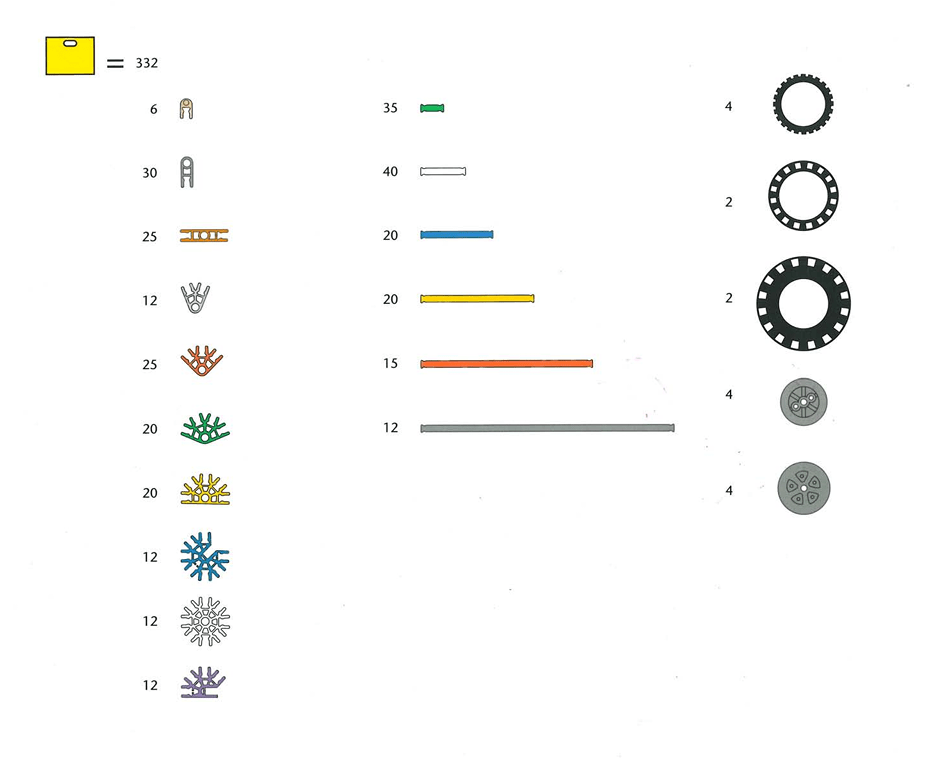
Rods and connectors form the core construction system, but other basic components greatly extend what can be built.
Early Classic K’NEX building also made use of parts such as clips, wheels, tyres, hubs and pulleys.
Clips provide additional ways of connecting, retaining or positioning components. They differ from the larger rod-and-connector connections and can perform more specialised functions.
Wheels and tyres make vehicles and other moving constructions possible.
Hubs can hold tyres, while some hub components can also function as pulleys in mechanisms.
These components add useful functions to the underlying rod-and-connector structure rather than replacing it.
Parts can have more than one function
K’NEX components are not always best understood through a single classification.
A hub, for example, may form part of a wheel assembly in one model and function as a pulley in another. A clip may retain an axle in one construction and form part of a different type of connection elsewhere.
This is important when identifying and classifying K’NEX parts. A component can be described by its physical form, function, building system, application or other characteristics.
For this reason, the K’NEXCHANGE catalogue can provide more than one way to find or understand a component.
A small building vocabulary
One of the strengths of Classic K’NEX is that complicated structures do not require a completely different specialised component for every purpose.
A relatively small vocabulary of rods and connectors can be repeated in different orientations to produce many different structures.
Basic additional components introduce movement and other functions, while rods and connectors continue to provide the underlying framework.
Over time, many more specialised K’NEX components were introduced. These can be explored separately in the Parts section.
 K'NEXCHANGE